Wednesday, April 17, 2024

What We Ate In Japan

In late 2019 we took a wonderful 10 day tour of Taiwan with Supera Tours, known at that time as Super Value Tours.  Unlike every other China tour we had been on (or for that matter, any tour period) the food was fabulous as the tour company carefully curated all of the meals on the trip to maximize our complete dining experience with a variety of food choices that few people visiting Taiwan on a group tour would ever enjoy.  Everything we ate on that tour is chronicled here (with the exception of one episode which got lost in the cloud and can be found here.)  We quickly decided we wanted to try another of their tours as soon as possible.   But scarcely two months after our return COVID hit, and it wasn't until now that we were able to go on another Supera Tour, this time in Japan.

The food on the ANA flight to Japan was better than the typical international airline fare.  First they gave a picture menu of entree choices.


A six course dinner, including ice cream.  Most of it was quite good.


However, the end of flight meal, considered to be breakfast even though it was late afternoon in Japan, was a disaster.  Orange chicken on the ANA flight was the worst I’ve ever had. Soggy and not much flavor. Moreover, what’s ANA even doing serving orange chicken in the first place? Perhaps in response to segment of the American public that doesn’t discern the difference between Japanese and Chinese food?


 Arriving in Tokyo Wednesday evening two hours later than scheduled, I was afraid the time for the first dinner of our tour had passed.  However Hanamidori was able to serve the members of our tour group in waves as we arrived.  First course was an interesting shredded daikon salad.


Also a nice slab of fish cake.


Main course was the specialty of the house, chicken hot pot.  Hanamidori was probably the weakest meal of the trip, but proximity to the hotel and flexibility to serve tour group members as they straggled into town likely trumped finding anything better.


Part of Supera's meal curation is to find hotels with excellent food.  As soon as we stepped into the Glass Kitchen buffet in the Keio Plaza Hotel, where coincidentally I stayed in 1980 in my only other visit to Tokyo, it was apparent that this was a high quality operation, with interesting dishes, and other amenities.  Two of my favorite dishes were fried tofu patties and sea bream with eggplant.


Ever had orange peel muffins?


Udon station, prepared to order!


How about some great low carbohydrate vanilla pudding?  I guess they couldn't figure out the word sugarless.


View of the small upper dining room where we sat once.


And a view of the main dining area from upstairs.


First lunch of the tour was this seafood rice casserole at Kamameshiharu Maru in the Akakusa section of Tokyo.  The main dish was delivered with a cover.


This is what it looked like inside.


For dinner on our own on Thursday, we stayed in house in the Keio Plaza at Kagiri Restaurant.  A nice high quality meal started with sea urchin with sesame tofu.


A group of seafood appetizers.


Whole grilled rockfish.


The best yakisoba I've ever had.


Assorted sashimi.


Grilled yellowtail.


Capped by refreshing dessert offerings


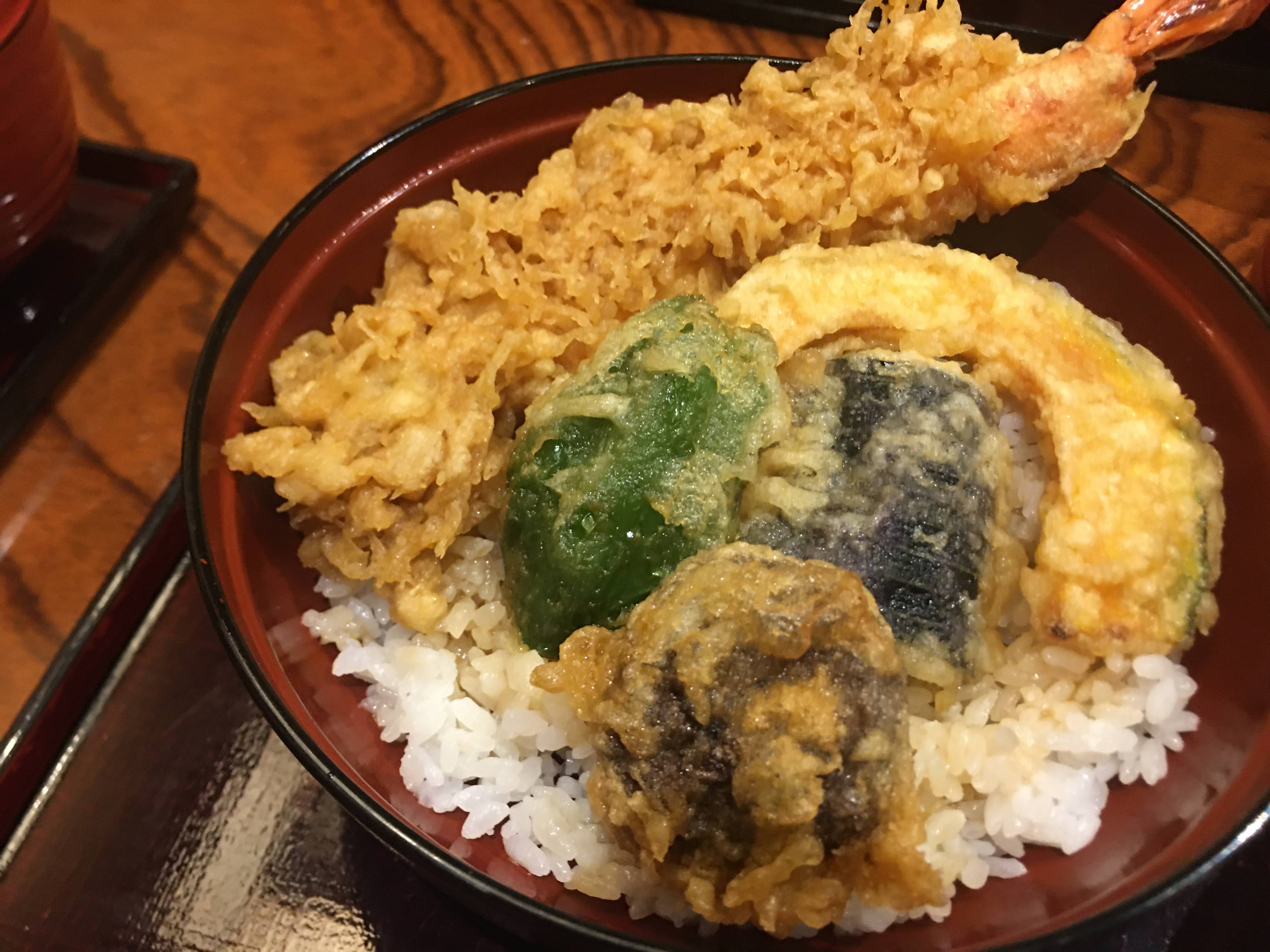
Thursday lunch was  at Minemoto Restaurant in Kamakura.  This is their signature tempura dish.  But in line with Supera's desires to give us a broad eating experience, they chose this specialist in non-crunchy tempura, a concept foreign to anyone who has only eaten crunchy tempura in the United States.


We also had these appetizers, including a really interesting Japanese tofu, much chewier that what we're used to in the United States.


Also soba in broth, though nothing to compare with the previous night's dinner.


Some awesome dried white peaches and other fruit for sale on Komakidori Street in Kamakura.


Our next two meals were at the buffet at the Odawara Hilton Hotel and Spa.  Interestingly, this was the most Westernized of all the hotel buffets on the trip, surprising since this was a traditional Japanese Ryokan style hotel.  For example here's the scallop pineapple pizza.


Interestingly, a dish for the season--cherry blossom tartare (sic) sauce, to be used in conjunction with their fish nuggets.


And at breakfast on Saturday, plain cold udon in ice water.  Strangely this was by far the most popular Instagram post of the trip with over 450 likes.


I didn't actually eat these, but these Mount Fuji replica cakes for sale in Gotemba, at the base of Mount Fuji, caught my eye.  A bit strange since it's not exactly a lasting souvenir.


Meanwhile at the Mt. Fuji viewing area itself, we got a sample of sweet potato fries.


After our first viewing of Mt. Fuji, it was on to Funari in Kawaguchiko, for some Hotou Futonaga udon.  This is a unique Japanese noodle local to the area around Mt. Fuji.  This was the first of a number of restaurants on the tour that had massive local crowds waiting to be seated, while our tour group jumped the line into our reserved space, another testament to the care that Supera takes in choosing its dining venues.  This noodle is so popular that people travel from Tokyo to eat here, because the dish is not available in Tokyo.  But for me it wasn't transcendental since it's actually similar to Chinese hand pulled noodles.


At the Kubota Art Museum in Kawaguchiko a visit to the Kubota Art Museum included a sample of matcha green tea in the tea room.


And Saturday night it was back to Tokyo for a great BBQ dinner at Toraji on the 46th floor of the Shiodome Building.  First off was the wagyu.


We all had seats looking directly out the window offering a stunning view of the Tokyo night skyline.


With an assortment of BBQ beef and other items.


On Sunday morning it was on to Tokyo Station and the bullet train to Kyoto.  We were taken to the Daimaru Department Store bento box food court next door to select our bento boxes for the 2½ hour train ride.  What a fascinating area with a wide range of meals to purchase.


I ended up at Shang-hai Deli since I knew some people would ask me about how the Chinese food was in Japan.


I bought a selection of siu mai, which included something I had never heard of, Shanghai siu mai, which is filled with sticky rice.


Along with some fish cake patties.


Also grabbed a pack of sushi, which turned out to easily be the best of the bunch.


Arriving in Kyoto, we went to the Biwako Hotel in Otsu for the crown jewel meal of the tour, the multicourse Kaiseki dinner.  This is the type of meal that distinguishes Supera Tours from the rest of the pack.  We started with sesame tofu, horsetail, clam with ginger miso dressing and lilly bulb.


Shrimp and small seabream with yolk, sweet fish, soft seabream roe, rope blossoms, bracken.


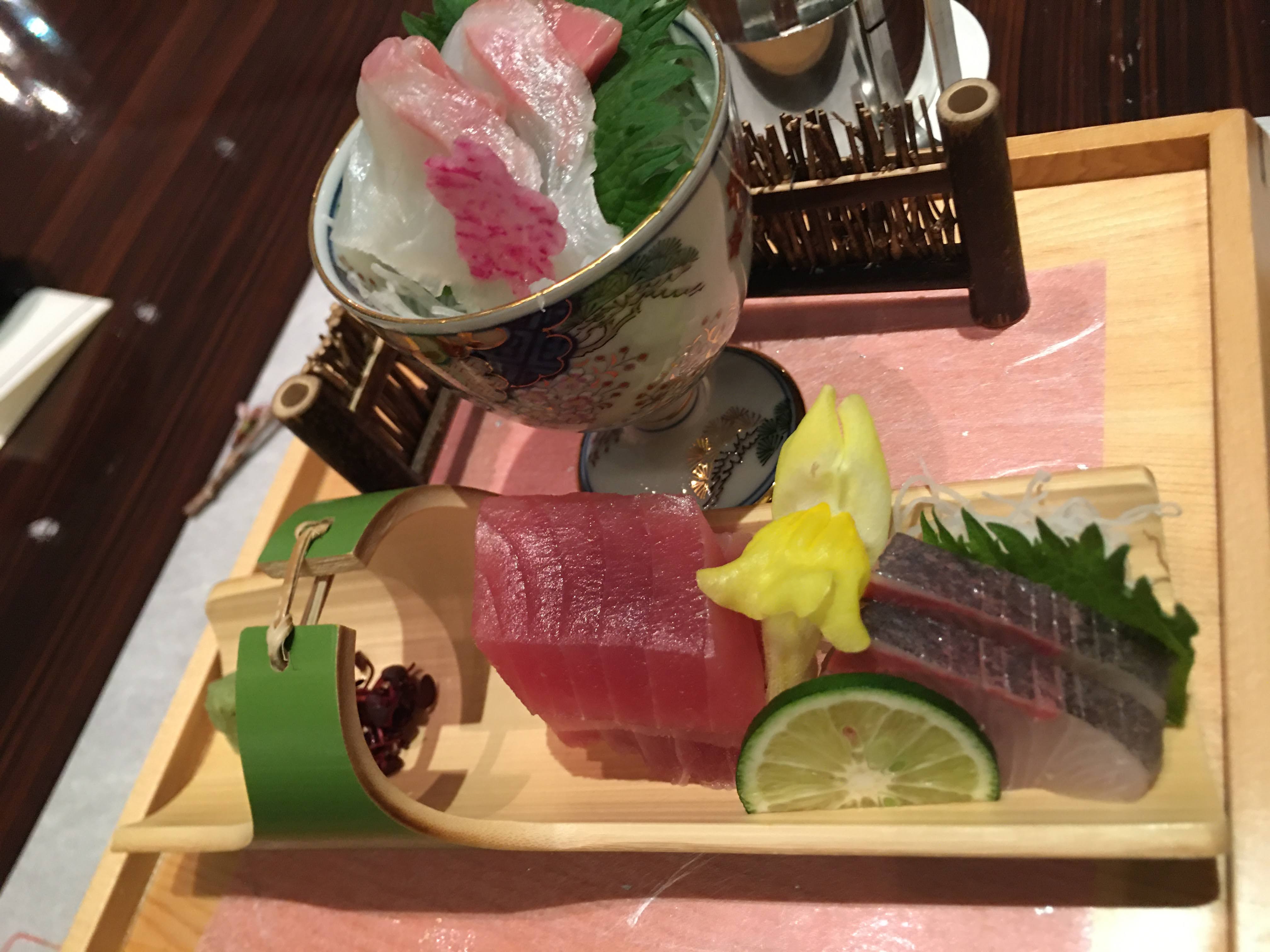
Tuna, seabream, amberjack and squid sashimi with cherry blossom.


Soft boiled bamboo shoot and seaweed, deep fried tofu fritter, butter bur, fu, bud.


Spanish mackerel grilled with bud miso.


Sakura shrimp Kariage, conger eel tempura and ostrich fern.


Oumi beef and wild herb sukiyaki with baked tofu and vegetables.


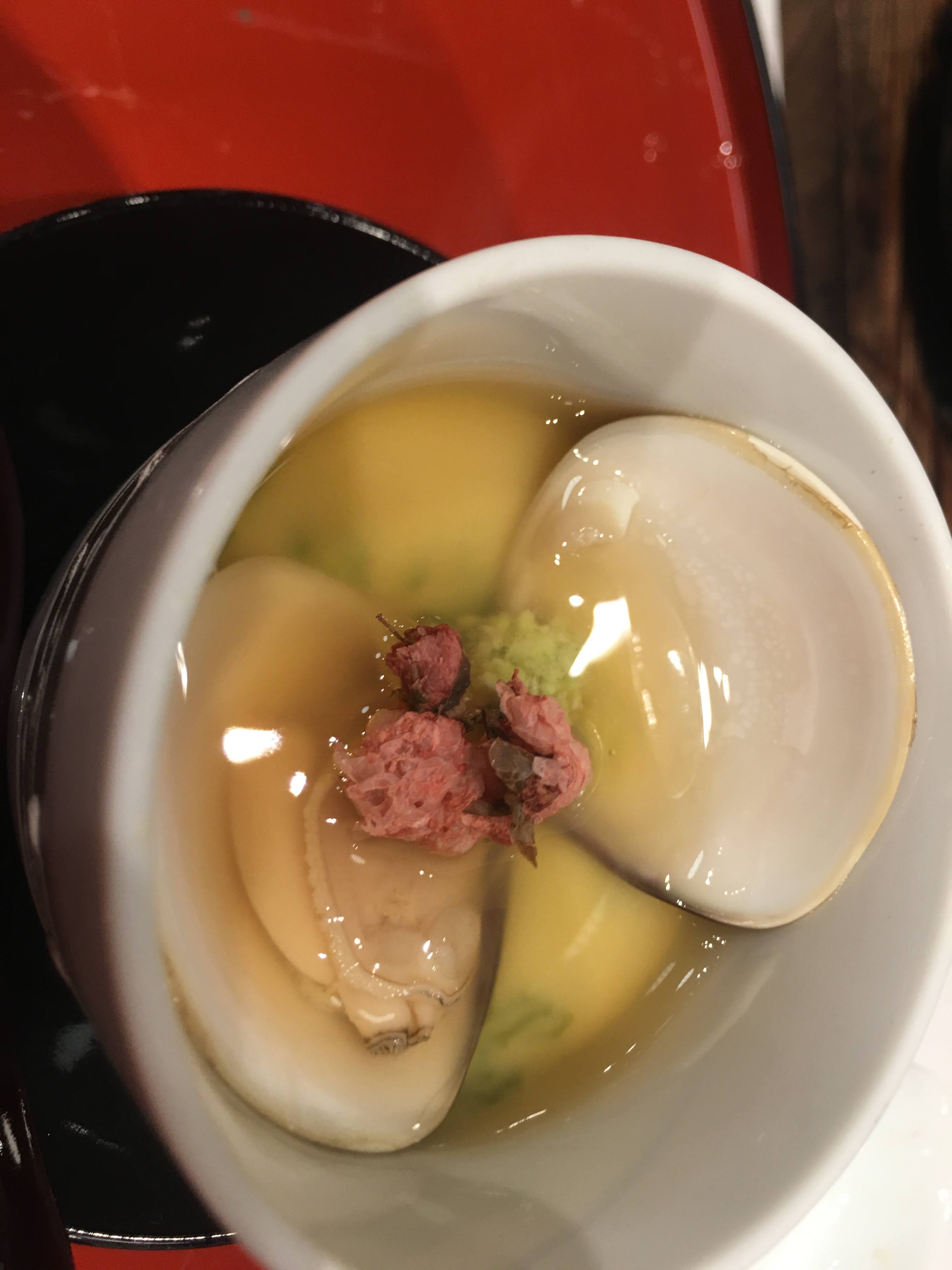
Clam and sea lettuce egg custard.


Red miso soup.

Mochi.

 
The Monday morning buffet at the Biwako Hotel was also excellent, highlighted by some surprisingly good dim sum like these green har gow and pork siu mai.


Moving to the Arishiyama section of Kyoto, we had a pre-luncheon snack of sesame silky tofu ice cream at Kyuozan, so sticky that you could turn an ice cream cone upside down and it wouldn't spill out.


Then it was across the street and another line jumping reserved lunch at the crazy busy Hanana Restaurant which specializes in sea bream dishes, particularly this one with green tea rice.


Appetizers, steamed eggs and vegetables.


Thin sashimi seabream.


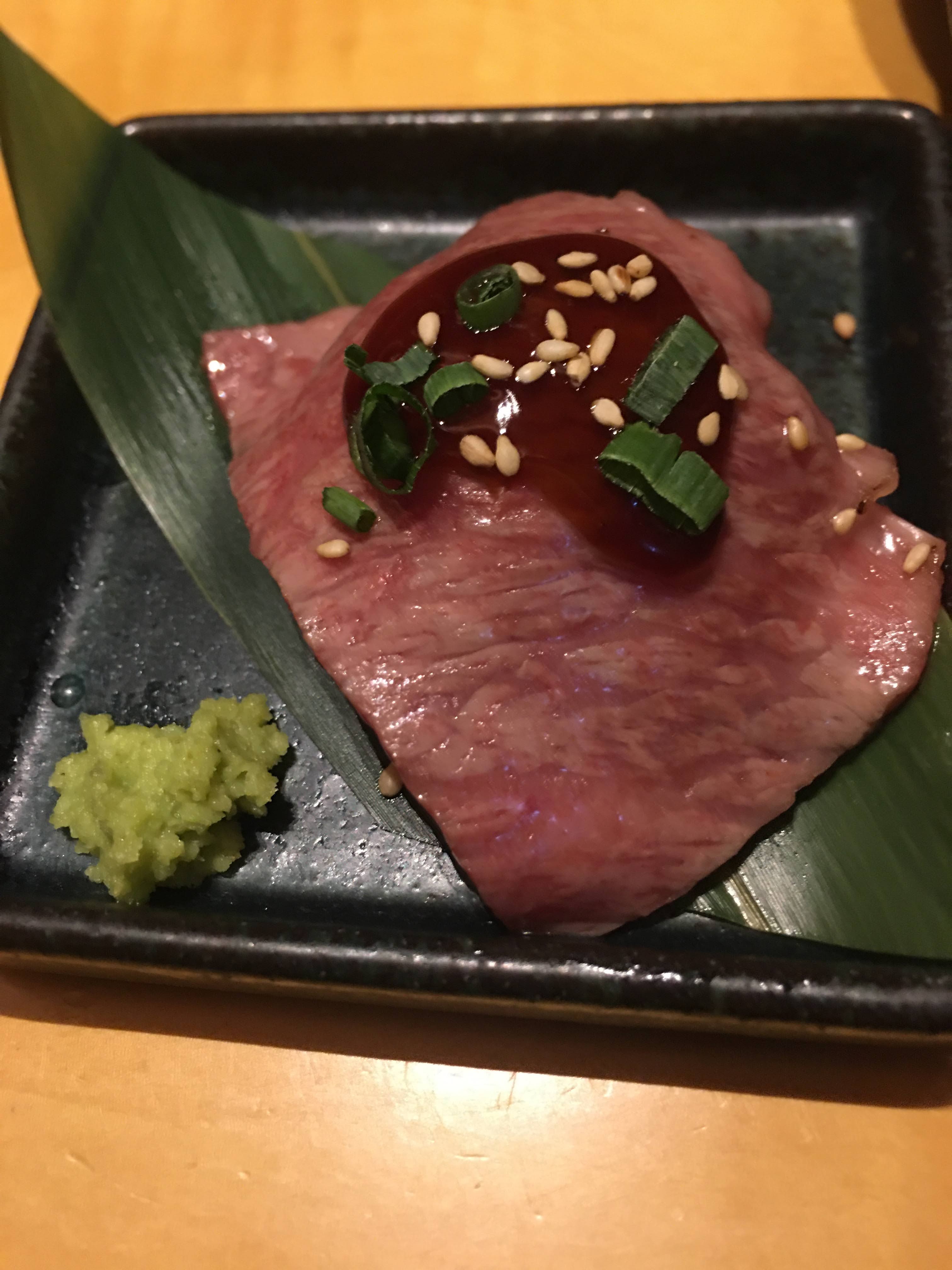
Monday night was the wonderful Teppanyaki dinner at the Osaka Okura hotel, another one of the meals I've come to expect from Supera.  Tops on the list was the Kyoto beef.


Along with an assortment of goodies including meat, fish, mountain yam, pumpkin and other vegetables.


But nothing beats watching the chef light his fire.


All capped by a simple dessert.

 
On our after dinner walking tour of downtown Kyoto, we passed a tankful of blowfish embedded in a restaurant's front wall.  Not sure if I'd want to try these.

The breakfast buffet Tuesday at the Kyoto Okura was also excellent.  XLB were major league, as were the siu mai.


On Tuesday's walking tour of Kyoto, we stopped for coffee and tea at Chourakukan Dessert Cafe in Kyoto’s Marayuma Park. Thanks again to Supera Tours for finding venues like this one which is over 110 years old. We certainly would never have found anything like this on our own.


A nice pre-lunch resting spot was Maccha Cafe in one of the old town alleyways.  This is their macha parfait.


For a change of pace lunch, Supera booked Sodoh Italian restaurant for a taste of Japanese style Italian food.  Interesting utensil set up, with a molded rest with specific spaces for chopsticks and western cutlery.


Main course was onion fusilli.

 
White bean soup.

 
Kyoto pork.


Salad.


Strawberry dessert.


Dinner was on our own so we had a simple dinner of Kyoto ramen at Karikaya.  A vastly different kind of ramen noodle.  Indeed, I wouldn't otherwise consider it to be ramen.  One thing I hate about most tours is that there are very few lunches and dinners included.  Our Supera tour had only three meals not included, and that was strategic as there was one on our own dinner in each major stop of the tour which was coupled with a night tour to give you a feel of the dining options available.


It was the last leg of our tour on Wednesday with our luncheon stop at Yoshino for what I would call at bento box skyscraper.


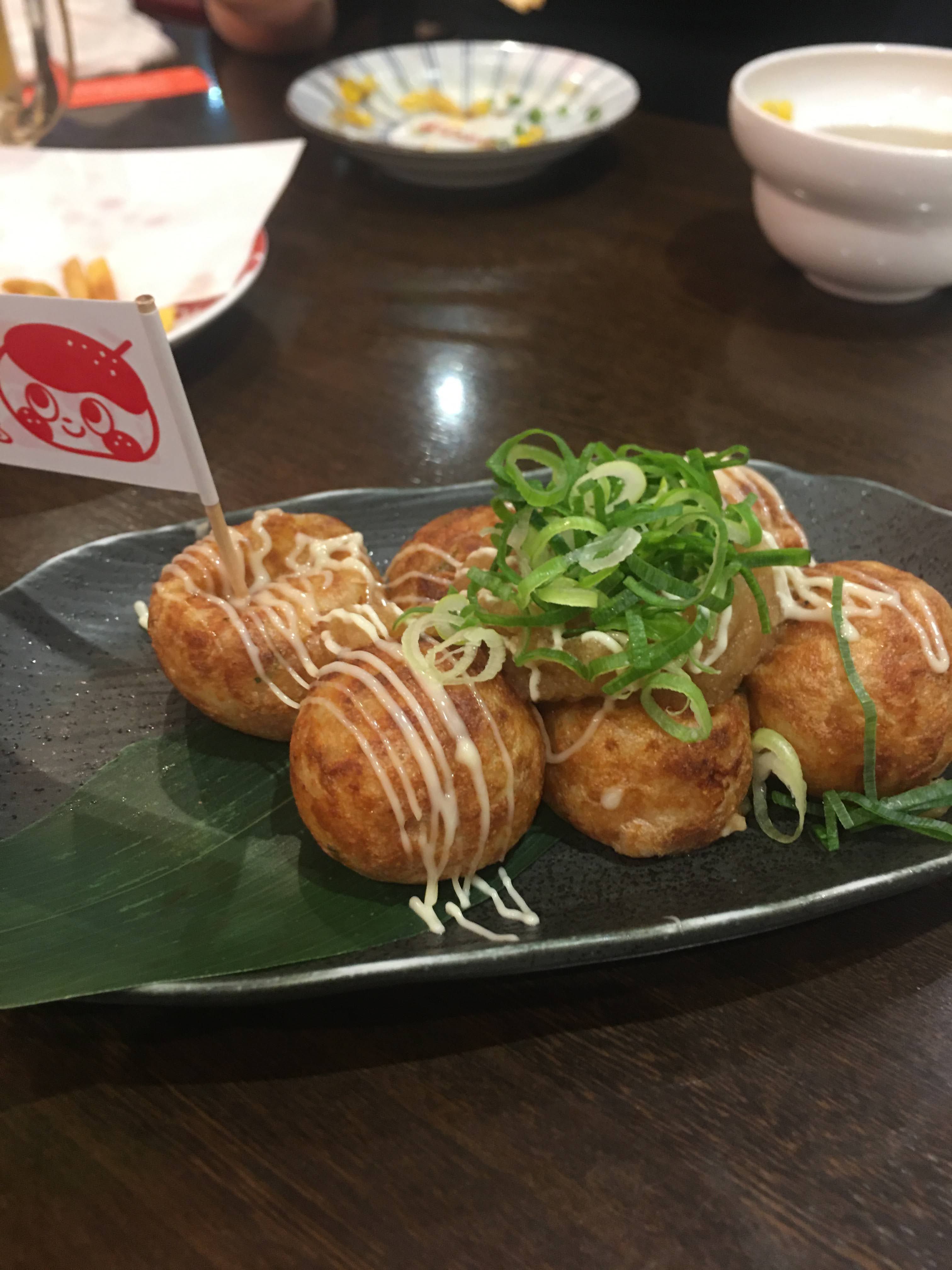
Wednesday dinner was on our tour of the Shinsaibashi shopping area in Osaka and Dontoburi dining street.  One problem of dining on your own in Japan was that the dining areas are so crowded, even on weekdays, that you probably have to settle for a second or third choice as many venues are not available or have long waits.  Fortunately our Plan B dinner at Creu-Ru turned out well as there was no waiting and we had a nice dinner.  Creu-Ru describes itself as a Takoyaki and Okonomiyaki restaurant.  This is one of their many varieties of takoyaki, though you'd never have an idea that there was any octopus in there.


The surprise of the menu was seeing something called Shanghai style yakisoba.  Seems to be a contradiction in terms.

 
A common dish throughout the trip, both in the buffets and appetizers, was Japanese style eggs.  Much softer that what were used to.


A nice dish of scallops.


Chicken karaage, delicious and crunchy.


Thought we were getting chicken nuggets, but I think these were really chicken gizzards.


Beef and fries.


A soupy bowl of beef stew.


The final meal of the tour was breakfast at the Imperial Hotel in Osaka.  Amazingly outstanding dim sum in the buffet.  Never seen anything like the fish paste festooned with rice.


Siu mai was excellent.


Crispy seafood egg rolls were excellent.


Final meal at Osaka airport was this Japanese hamburger at Sakifukuya Cafe.  How is this different from regular hamburger?  It's soupy.

 
More Japanese fried chicken.


With assorted trimmings.


All in all a great tour with many food highlights.


Friday, March 15, 2024

15th Anniversary of Chandavkl's Blog


Since this year is the 15th anniversary of my writing this blog, and because I did not celebrate the 10th anniversary five years ago, I thought I would put up a brief anniversary post.  Back in 2009, I had not yet been discovered by Clarissa Wei and turned into a celebrity diner, so Chinese food and restaurant topics were only a part of the content on this blog.  

Furthermore I wasn't particularly knowledgeable about some of the workings of the internet, I treated my blog as a personal diary, just to keep track of some events and thoughts that I might otherwise forget.   I was happily uninformed about what it meant to have a blog on Google's Blogspot/Blogger product, until one day when I decided to see a search of what kind of Cantonese food blogs were on the internet.  Yikes, to my surprise I saw my own blog listed on the first page of Google hits.  Up until then I had no idea that anybody might have seen blog posts except myself.  I then did a little digging into the workings of the blog itself and found a tool called stats, and that yes indeed, my blog was attracting a small amount of traffic.  Not that I had posted anything inappropriate, but now I was on notice that I would have to write the blog with outside readership in mind.
 
In the Spring of 2012, Clarissa Wei's article came out and that changed everything.  The effect on Chandavkl's Blog was significant, but not in the way that one would expect.  Rather all the publicity as the celebrity diner who had eaten (then) at over 6,000 Chinese restaurants led to requests to write about Chinese food for other websites.  Consequently, any really serious piece on Chinese food that I would write appeared on these other websites.  Of course, I recognized that people would expect that I had my own blog on Chinese food topics, so I did keep Chandavkl's Blog current, largely with less profound articles about where I ate for lunch or what I ate on my vacation.  And I would post early summary drafts of my outside articles, too.  But the banner on Chandavkl's Blog referred readers to my articles on the Menuism website, where I penned about 90 articles over the course of almost 10 years on Chinese food in America in the context of Chinese-American history, demographics and culture.
 
My run with Menuism ended in 2022 when their blog editor left, leaving nobody there to shepherd articles onto their website.  When I first started with Menuism they had a stable of over a dozen bloggers, each with their own culinary specialty.  By 2022 I was their last writer standing.  In a way it was a relief in that it was getting difficult to write so many substantive articles on a monthly basis.  Shortly thereafter, while the Menuism site carried on, trying to reach the Menuism blog site or any individual articles only generated an error message.  To me that was my worst nightmare, since much of my major work was no longer on the internet.  On the other hand, I had thought about that possibility, so I contemporaneously saved HTML and PDF copies of all my articles as they were written.  While I had no idea of the mechanics of creating a new website with the content, at least I had the raw material.  And after some false starts and experimentation, I decided I could start a second Chandavkl blog to preserve all of my Menuism articles.  In so doing I wasn't even thinking about people finding my articles on the internet, but rather I just wanted to have them on the internet so I could provide links to my writings if anyone wanted to read them.
 
Of course you know what they say about the best laid plans of mice and men, and as it turns out some of the HTML copies of my Meniusm articles were corrupted.  Furthermore, at some point in time copying and pasting PDF text became a premium item, so I needed a Plan B for some of the articles as I could not copy and paste from the PDF.  That came in the form of locating the original text submissions of my articles, and at least I could copy the illustrations from the PDF copies.  So it took me just a month to get Chandavkl's Menuism Blog up and running.  Indeed, it looks so nice that I've subsequently added some new material to the new blog.  So to that extent, the original Chandavkl's Blog is still just a miscellany of less important topics, while the new Chandavkl's Menuism blog is where more substantive items will be found, even where they were not originally posted on Menuism.

And appropriately, in reviewing my first few posts from 2009, this is a good opportunity to make an addendum to one of them. In 2009 I was describing my trip to Nashville, where my son and I were going to visit for a few days.  However my son's vacation was cancelled by his employer at the last minute and I ended going by myself.   As I said in that post, "I was looking forward to seeing Music Row, since it is the heart of the country music industry where hundreds of record companies and country music related endeavors were located. I was imagining it was in downtown with shops, nightclubs, museums and buzz of activity. Was I ever mistaken. Music Row is two parallel tree lined streets, four blocks long, and the functional equivalent of a business park with low and mid rise office buildings. No retail space, no foot traffic at all."  

While this always puzzled me, it's not like it was a question that I had a burning desire to resolve.   However, I happened to see that a film on Music Row was being shown by PBS, so I made it a point to watch it.  And the show explained everything.  Country music was driven in the old days by Nashville radio stations, which had a need for their own recording facility.  So one such facility was built in a nondescript residential neighborhood which is now Music Row.   This facility was such a success that over the years all the record companies built their own studios here, and related businesses set up shop.  While many of the old residences were replaced by office park type buildings, some of the old houses are still there today.


Thursday, February 29, 2024

2024 - The Year That Lunar New Year Went Mainstream in the United States

So we're less than a month into the Year of the Dragon, and I cannot believe how mainstream Chinese New Year became this year.  Seemingly every national brand, every major retailer, every designer name, had some kind of New Year special.  Indeed when I saw Lunar New Year Hershey bars and M & M Candies, I almost lost it.  Why so suddenly and why this year?  I haven't the faintest clue.


The cynic in me knows it's just a marketing ploy, but I'm certainly not unhappy with this development.  But it's not just the suddenness of being able to celebrate Lunar New Year with Mickey Mouse that I find overwhelming.  Rather it's something deeper than that.

You see, growing up in Los Angeles as a kid in the 1950s and 1960s we never celebrated Chinese New Year.  While that may sound strange, it was a different Chinese America back then.  Most all my family and Chinese friends were American born Chinese. My parents were American born as were all my aunts, uncles and cousins.  My parents' friends were also American born Chinese. The only immigrant Chinese in my life were my material grandparents, and they were so busy working 12 hours a day, 7 days a week at their small neighborhood grocery store near the University of Southern California campus, that there was no time for any kind of family gathering.  

You may wonder how this American born Chinese society developed in mid-20th Century United States.  It was the result of the Chinese exclusion laws, enacted by the United States in 1882, and not repealed until 1943, which prohibited most Chinese from immigrating from Asia to the United States.  And even after repeal of the law in 1943, the annual immigration quota for China was 105 persons, until repeal of the national origins quota system in 1965.  In actuality, there was some continued immigration of Chinese to the United States during the Exclusion and low quota periods, but much of it was illegal.  Indeed, three of my four grandparents came to the United States illegally. 

Actually there were two different Chinese American societies during the Exclusion period.  There was the second and third generation model I described, but to be an American born Chinese obviously meant that both your father and mother resided in the United States.  However during the Exclusion period there was an incredibly imbalanced sex ratio among Chinese in America, as high as 27 males per female.  Consequently during the early 20th century, the American born Chinese model was very rare, and most Chinese Americans were male "bachelors."  

Technically they weren't bachelors, as most of them were married, but their wives were back in China, unable to come to the United States due to the immigration laws.    As time went on, the ratio did begin to equalize as many old bachelors died off or returned to China.  And the American born segment of the community really really expanded after World War II, as the so called War Brides changes to the immigration law enabled many Chinese American men to have their spouses join them in the United States.  

So as I was growing up, there were a good number of second and third generation Chinese Americans in Los Angeles, and indeed there were few Chinese American contemporaries in Los Angeles who were not American born.  It took a while after the end of the national origins law passed in 1965 for the presence of new immigrants to be reflected.  Indeed, as late as 1970 I was stunned to learn that one of my Chinese American friends had been born in China, and immigrated to the United States as a 5-year old.  No wonder it was my generation of Chinese Americans that first applied the term "FOB" to new immigrants from China.

With this background where many Chinese Americans in Los Angeles didn't celebrate Chinese New Year, no wonder why I'm so totally blown away by the mainstream attention paid to Lunar New Year this year.  One final example of this revolution involves Chinese food.  Of course, most Chinese Americans in Los Angeles now follow the Chinese New Year food traditions, and it's been this way ever since the wave of Chinese immigration has swelled the Chinese population in the Los Angeles area from the 10,000 when I was born to the more than 500,000 today.  And it's certainly not unusual for Angelenos to want to partake of a Chinese restaurant meal around Chinese New Year, as I would receive more requests for Chinese restaurant recommendations from non-Chinese friends during this period.  However, I really don't recall any active marketing of Lunar New Year by Chinese restaurants.  But this has changed, as for the past two years Paradise Dynasty in Costa Mesa, which has a mixed clientele of Chinese and non-Chinese diners, has actually developed a limited curated Chinese New Year menu, this year available through March 31. 


And me.  I'm certainly not complaining about the new normal.

Thursday, February 1, 2024

Laughter and Tears--Chinese Food on the Sapphire Princess Antarctic Cruise

Since we and everyone else began to take cruise ship vacations again after COVID, I have noticed that the percentage of Asians, primarily first generation Chinese Americans and Chinese Canadians, has been significant.  As such, on the two Mexican Riviera cruises we took out of Los Angeles about a year ago, there was quite an offering of Chinese food, some good, much not so good,  but at least conspicuously present and recognizable at most meals.

Likewise on last month's Sapphire Princess cruise starting in Buenos Aires, cruising four days in the Antarctic, and ending in Chile, there was like a high quotient of Chinese passengers on the boat.  And overall this was the best vacation trip I have gone on.   However on this trip, when it came to Chinese food it was pretty uniformly gruesome.  The overriding feature was the large number of dishes with familiar Chinese names that neither looked nor tasted like the real thing.  


Hot and sour soup looked like chicken rice soup and tasted like chicken broth with some pepper added.  


Kung pao chicken was big chunks of chicken white meat in tomato sauce.  Peppers?  Peanuts?  What are those?


Sweet and sour pork was unbreaded pork strips of pork (fajita like) in a clear sauce.  (Sorry, no picture.  I couldn't bear to photograph it at the time.)  Sesame chicken looked like McDonald’s chicken nuggets with a dipping sauce.  And mind you, this dish was in the main dining room, not the buffet.


They had char siu – in cutlet form in a goopy sauce.  Another day it was the carvery item (without the goopy sauce.


Shanghai beef fried rice (what’s that?) looked more like Spanish rice.  


And how could you come up with a head scratching version of jook?  Well, by making it greenish yellow, I guess.


And unlike the Indian food, which had it’s own section at lunch and dinner every day, the “Chinese” food was very sporadic.  There was one “Mongolian night”, but the only notable feature about that was that it was cooked to your order.  You’d choose from beef, pork, chicken or vegetables, then either chow mein or rice, then spicy or nonspicy.  Oh, and this was the last dinner on the cruise so they wanted to do something special for the Chinese passengers.  (Note that dishes were for "Display Purposes Only.")  Why bother?


I posed the question to myself during the cruise "What Chinese recipe book were they working from?"  However, now it's clear to me that Princess did not have a recipe book for their Chinese food.  They gave the names of Chinese dishes to their cooks, and told them to make something up from scratch based on the name.  That's the only possible explanation.


Monday, January 1, 2024

Artificial Intelligence And The Fake Chinese Restaurant Backstory

I'm always on the lookout for new Chinese restaurant openings, particularly in the San Gabriel Valley.  Obviously a newly opened restaurant is the most likely source to add to my Chinese restaurant count.  Also, since I have been eating in the San Gabriel Valley ever since the first authentic Chinese restaurant opened up in the mid-1970s, by catching new Chinese restaurants right when they open, I have been able to eat at the vast majority of authentic Chinese restaurants that have ever operated in the San Gabriel Valley.

One Saturday night we were driving home after dinner in Alhambra, when we drove by a brightly lit new Chinese restaurant near the corner of Valley Blvd. and Garfield Ave.  I noted the name of the restaurant, Chong Yuen Fong, to see if there were any reports on it.  To my surprise, I found a webpage and a most interesting back story indicating this was the new branch of a long time downtown Los Angeles (presumably Chinatown) Chinese restaurant.


As noted above, the story was that Chong Yuen Fong was originally founded in 1997 “in the heart of Los Angeles” , and immediately became a hit with people from all over Los Angeles, and becoming a beloved institution, particularly for their egg tarts and Hainan chicken. Now the founder’s children have taken over the business, with their new location in Alhambra.

Now, as you know I’ve eaten at almost every Chinese restaurant in town, and I never heard of a restaurant called Chong Yuen Fong. I guess it’s possible that Chong Yuen Fong was the Chinese name for a restaurant that had a different English language name. But the only place in Los Angeles where that could be a possibility would be in Chinatown, and if they were located in Chinatown why wouldn’t they say so?

One restaurant which could possibly fit the description is New Dragon Seafood which opened in Chinatown in 1997 and closed during the pandemic, though I ate there a few times and don’t remember seeing egg tarts and Hainan chicken.  And indeed, the more I thought about it, the more puzzling it became because upon deep reflection I don't remember Hainan chicken being available in Chinatown.  Searching for answers I posted all this on the Food Talk Central message board.  The responders all found this strange, and many suggested this description was the product of artificial intelligence.  Surprisingly, though, the posting did eventually clear everything up, as an associate of Jay Leung replied with this post.


It’s a pleasure to see your interest in our restaurant. I’m Brett, the owner’s cousin, and I’d like to provide you with some insights. The website was developed hastily, and I must confess that the “our story” section isn’t entirely accurate. As others have pointed out, it was generated by ChatGPT. The reason behind this rush was that the city of Alhambra mandated that every restaurant have a website, and I managed to create this one in just 50 minutes.

Regrettably, I didn’t have the opportunity to craft a genuine narrative about the restaurant and its menu. I offered a brief overview of the owner, Jay, who originally hails from Guangzhou, grew up in Hong Kong, and then immigrated to Los Angeles. Jay’s English is somewhat limited, and he plans to enroll in English classes next year once things settle at the restaurant. English is my second language too, and I’m currently pursuing English courses in college.

We sincerely apologize for the ChatGPT-generated content. Please allow us some time, and we are committed to revamping the content and story on our website. We appreciate your understanding during this transitional phase as we work on improving. Our restaurant has only been open for ten days, and we’re still learning the ropes. However, the food we serve is authentically Cantonese, and we promise to enhance your dining experience in the days to come.

Thank you for considering us, and we look forward to welcoming you back for more delicious Cantonese cuisine.


Mystery solved!  And they replaced the AI backstory with a real one.


Sunday, December 3, 2023

Fujianese Style Food Returns To The San Gabriel Valley


So if you asked the typical person on the street in the United States what part of China or Asia produces the lion's share of Chinese restaurant ownership in the United States, very few people would correctly guess Fujian Province.  On the other hand, if you asked any person in California whether they had ever eaten Fujianese style food or at a Fujianese owned restaurant, 99 percent of the people would probably say no.  

As I originally wrote in Menuism a few years back, the Chinese American restaurant world is divided generally into halves--roughly west of the Mississippi River and east of the Mississippi River.  The reason is that in the past 35 years there has been a massive migration of people from Fujian province to Manhattan Chinatown who engage in the restaurant business.  And then these Fujianese migrate outwards from Manhattan Chinatown in all directions through a massive bus system, that permits the heavily undocumented Fujianese population to travel around the country, despite not having the identification to ride airlines or trains.  The extent of their travels roughly parallels the Mississippi River, since that's as far as a bus from Manhattan can get in a long day's drive.

With the Chinese restaurant industry being so mom and pop oriented, hard information on the workings of the Chinese restaurant was hard to come by, until one recent pivotal event.  That is when H F Foods Group, A Fujianese American food service company, filed an initial public offering to sell stock in their corporation.  H F Foods was the dominant Chinese restaurant supplier in the Southeast, and provided previously unknown information about what was going on, including the fact that Fujianese mom and pop Chinese restaurants constituted 80 percent of their customer base.   

So that explains why there is such Fujianese influence in the east, south and midwest, and virtually none in California, except for a longtime Fuzhou grocery store in Monterey Park.   Depending on who's in the kitchen, there might be one Fujian style restaurant in Los Angeles, Foo Chow in Chinatown, best been known for being a filming location for Jackie Chan's Rush Hour movies.   However a few months ago a new restaurant, Zhang Sheng Xian opened up in Rosemead, though at the time it was not evident that they were a Fujianese restaurant.  Rather, they had a wild assortment of dishes which had people suspecting that they were purveying specialty Taiwanese dishes.  Indeed their "characteristic bamboo tube rice" clearly screamed Aboriginal Taiwanese food to anyone who had visited the Aboriginal tourist haunts in Central Taiwan.  Plus the menu included several other Taiwanese dishes, along with Shanghai dishes which are popular with Taiwanese diners.


But, on the other hand...  There was a real puzzle here.  If it were a  Taiwanese restaurant, why would the menu use simplified Chinese characters as used on the mainland, rather than traditional characters used on Taiwan.  And there were at least a couple of Fujianese dishes on the menu, most conspicuously peanut butter noodles.  Oh and one commenter noted that that was a Eastern Guangzhou vibe to the place.  

So not knowing what was going on I returned recently with a Taiwanese friend.  Already the bamboo tube rice was gone, though apparently it really didn't provide a visible superior product to normal cooking to warrant a price premium. And my friend started talking with the staff, and he said they self-identified as a Fujianese restaurant.  But also noted that he felt a Guangzhou vibe too, so perhaps it's a western Fujianese restaurant.  In any event, the one and only in the San Gabriel Valley