Monday, April 6, 2020

Why I Was Wrong About Gibraltar

2018 was a climatic travel year in that we visited three locales where I never dreamed I would ever visit.  Well maybe I dreamed of visiting these places, Dubai, India and Gibraltar, but I never thought it would actually happen.  Now when traveling anywhere you haven't been before, you can see pictures before your trip to get an general idea of what the destination is like, but of course there's nothing like actually being there.  However, in the case of Gibraltar, the reality turned out to be 180 degrees different from the expectation.

The reason for the gap between expectation and realization was the purchase of this computer that I am currently writing on.  It was a brand new Dell, Windows 10 computer, and Windows 10 instituted a startup screen showing landscapes or other pictures of Windows' choosing, sometimes identified, sometimes not identified, showing up for several startups and then disappearing not to be seen again.  One of the early startup picture was something that looked like the Rock of Gibraltar, with the rock teeming with crowded structures all the way down the rock.  Since Gibraltar sits across the strait from northern Morocco, this Moorish type of scene seemed logical to me.  But like I said, the startup pictures may or may not be identified, and this one was not.

So imagine my surprise when I got to Gibraltar and found not a crowded Moorish landscape, but rather a sparsely populated British looking (obviously not surprising in hindsight since Gibraltar is British) one.  And while I was still excited to be in Gibraltar, this stark difference did diminish the excitement to some extent, though I also met my goal of having a meal there, if a ham and cheese french bun at the St. Michael's Cave gift shop can be considered a meal.

As I said, the Windows 10 pictures don't repeat themselves.  Except that two years later the picture that I thought was Gibraltar did reappear, and with identification.  What I thought was Gibraltar was actually Uchisar, a town in central Turkey, built around a large rock formation that actually didn't look like the rock of Gibraltar except for this one particular view.  And now I have a sense of closure knowing where I have to go if I want to see the Gibraltar I had imagined in my mind.

This is Uchisar.


This is Gibraltar.


Wednesday, April 1, 2020

I Wasn't Dreaming After All--This Restaurant Does Exist

When I first started this blog back in 2009, it wasn't a Chinese food blog, or any kind of food blog at all.  Rather I thought of it as a personal diary which I could easily access rather than fumbling around looking for some kind of paper book, never dreaming that anybody else would read anything I wrote.  As such I even posted some of my more unusual dreams on the blog.  

Which leads me to write about Wok N' Tenders.  Since Howlin Ray’s became a sensation in Chinatown’s Far East Plaza, turnabout would be fair play if a Nashville Hot Wings and chicken tenders placed opened up just down the street from Gus’s World Famous Fried Chicken on Crenshaw, and also served Chinese food on the side. But then if you told me that they’re serving Peruvian Chinese food I would have told you that I’m actually asleep right now and having another of my weird dreams that I actually used to post about.

Now the Chinese influence on food in Peru is quite real.  Chinese arrived in Peru at about the same time they came to the United States for the California gold rush.  Their presence has led to a style of cuisine called "chifa," based on the Cantonese term for cooking (in our Toishanese dialect, "ji faan") which literally means to prepare rice.  Chifa is essentially Chinese food made with local Peruvian ingredients.  There is also "chaufa", which specifically refers to Peruvian fried rice, from the Cantonese word "chow faan", which means fried rice.  The term chaufa also can refer more generally  to Peruvian food cooked Chinese style.

If you look hard enough you can find restaurants in the United States that serve a wide range of Chinese-Peruvian dishes.  There are a couple here in Los Angeles, though the greatest concentration I have run into was in Orlando, Florida.  Indeed, I actually stumbled into one in Buenos Aires.  But if you walk into any straight-up Peruvian restaurant in the United States, there will most likely be something in the way of chifa or chaufa on the menu.

Still, Chinese-Peruvian food is not so common here for me to find a Nashville hot wings/Chinese Peruvian restaurant and not think that I was having a strange food dream. But in fact I’m wide awake, and Wok N’ Tenders on the corner of Crenshaw and Venice is the restaurant, just two blocks from where I attended Mt. Vernon Junior High School in the 1960s, since renamed Johnnie Cochran Middle School.  Who would have thought something like Wok N' Tenders would eventually show up there?

The Chinese menu is relatively short. There’s chicken or beef chaufa (fried rice), chicken or beef tallarin (meat with noodles), and lomo saltado (Chinese stir fry with french fries). I had the chicken tallarin and it was really great.

IMG_20200330_1525224

Thursday, March 5, 2020

Chef Tony Staggers Into Town

Don't get me wrong.  The dim sum at Chef Tony's is quite good, innovative and visually appealing.  But when Richmond BC's best dim sum comes to the Los Angeles area, admittedly third tier behind both Vancouver and San Francisco, a nearly transcendental experience is expected.   They still may reach that point since they're still in soft opening, but Chef Tony is not currently ready for prime time, particularly in light of the hefty bill.  The first clue was walking into a restaurant at 11:10am to find only one other table of 2 occupied.  At the same stage, Longo Seafood's much larger premises were full by 11am and Palatte Tea House in San Francisco was likewise full.   Because I was a solo diner I could only try five items on this visit.

The crispy baked bbq pork bun was excellent, perhaps even the best I've eaten.  One issue, though is that there were sugar crystals sprinkled on top of the bun, making this the sweetest pork bun I've ever eaten.  Like I said it tastes great but I'm not sure if this is what I want in this dish.  The custom made bowl does add a nice touch.


Visually I was extremely impressed by the gold leaf shrimp dumpling which reminded me of the gold leaf dim sum I ate in Hong Kong.   But it tasted like any other good shrimp dumpling and was a bit pricey at $11.80 for an order of four (I paid $9 for these three.)


The pandan pork and shrimp buns looked very interesting.  Tastewise the only notable thing was that the bun was sweeter than the typical steamed bun.


The one really great thing about Chef Tony is that some dim sum items can be ordered by the single piece, so you don't have to worry about getting stuck with $8 or $9 for a full order of something you don't like.  This is the gold foil lava bun, which was excellent (though this is a hard dish to mess up).


Lastly, the signature coconut bunny.  Can't say it was better than anybody else' s coconut bunny.


At this point I think the question is whether Chef Tony is any better than its sister restaurant Sea Harbour or not.  (They're using Sea Harbour packed hand wipes right now.)  The dim sum certainly is prettier than Sea Harbour, but a deeper dive would be needed to see if it's equal to, better than, or not as good.  And then the question is whether it's worth the price premium, as the pictured items added up to over $37 including tax and tip.

Thursday, February 13, 2020

What We Ate In Taiwan

For longtime readers of this blog, you are aware that I don't often mention specific food dishes, nor do I include lavish pictures of food that I have eaten.  However for once I'm departing from this format with a 15 part pictorial write-up of the food that we ate on the trip we took late last year to Taiwan.  The reason for this departure is the wonderful tour put on by Supera Tours (www.superatours.com), the English language arm of the Signet Tour Company in the San Gabriel Valley and the array of extraordinary meals we had on the trip.  

For those who have taken a tour packaged in the Chinese communities of California or Canada, tour food wasn't anything to talk about, unless the talk was grousing about how boring and repetitive the food was.  That's because for many tour companies, food is a cost to be minimized in order to keep the tour price economical.  But in the end after hearing a number of people say that it seemed like they ate the same food every day on these tours (a description with which I concur) I wondered if it had to be this way. Fortunately we came across Supera Tours, which while not operating a high priced gourmet, foodie tour, provided food highlight after food highlight, which made me completely rethink the concept of the culinary end of Chinese tours.

The first segment of What We Ate In Taiwan, which covered the food we ate before the tour began,  was previously posted here. 

The next fourteen segments, generally discussed in chronological order on a venue by venue basis, can be found after this posting, except that the last segment does not appear here on the main blog page, but has to be linked directly due to a website glitch at http://chandavkl.blogspot.com/2020/02/what-we-ate-in-taiwan-part-14-farewell.html


What We Ate In Taiwan, Part 2 -- The Original Din Tai Fung


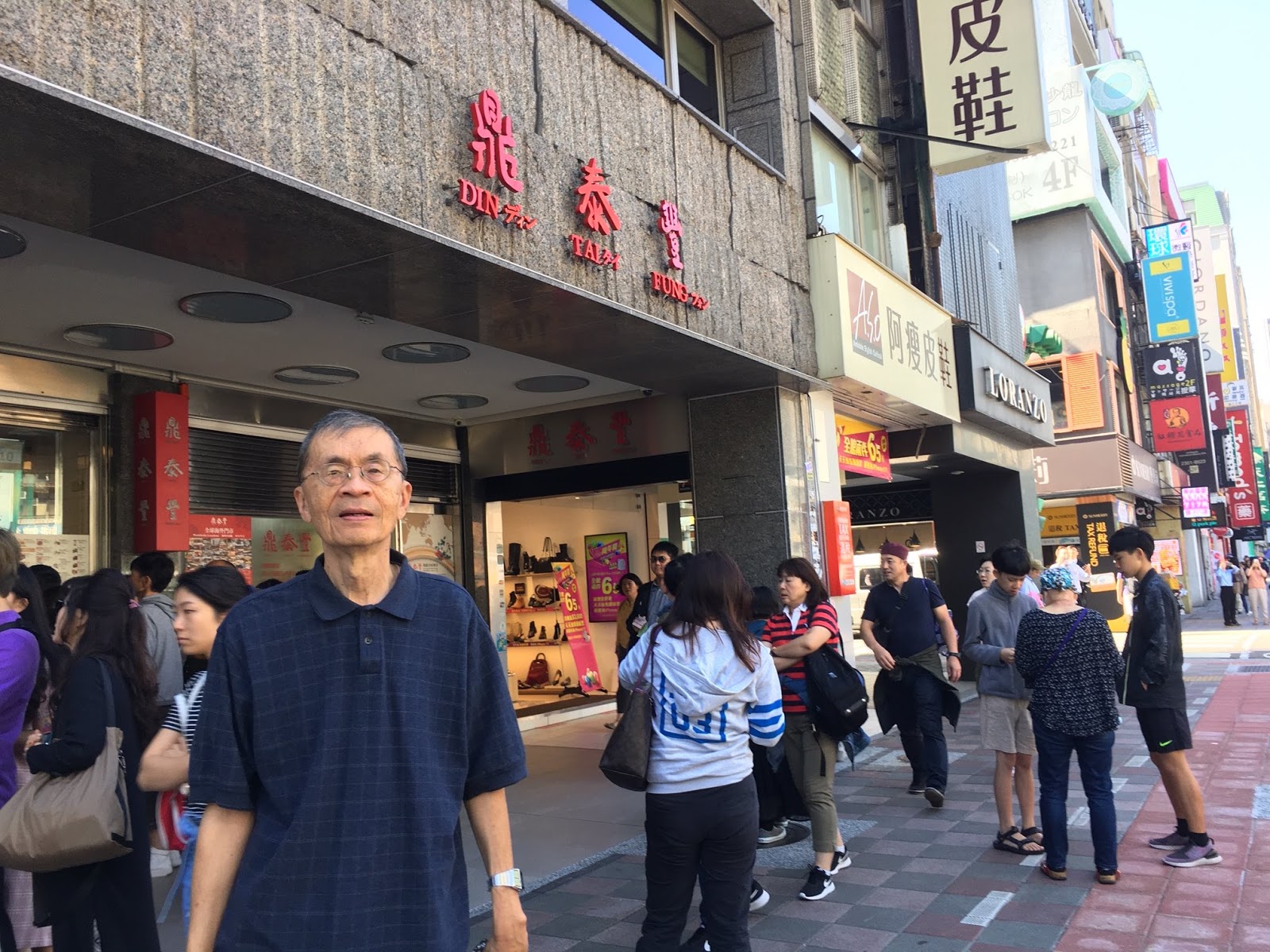
While the Supera/Signet Tours (www.superatours.com) promotional materials use the catch phrase "food=life" I was anxious to see if the tour would actually live up to the promise.  Well Supera Tours showed that they really meant business when they took us to lunch for the first official meal of the tour at the original location of Din Tai Fung in downtown Taipei.

Now Los Angeles area diners have been familiar with Din Tai Fung and their signature xiaolongbao, their open kitchen where you could watch the XLB being made, and other goodies created in the kitchen for 20 years now, ever since they opened up in Arcadia in the San Gabriel Valley.  It did not take long for that restaurant to reach cult status, and Din Tai Fung was the toughest Chinese restaurant ticket in town, as people lined up outside the restaurant daily before opening, or experienced extended waits during the day.  Despite everything, Din Tai Fung refused to expand beyond their relatively small Arcadia store.   Their fame spread far and wide across the United States.  A week long pop-up in Flushing, New York Chinatown was sold out, leading New Yorkers to believe that they were in for their own branch of Din Tai Fung, but that didn't happen.  Heavy rumors said that Din Tai Fung was going to open up in the Vallco Mall in Cupertino in California's Silicon Valley, but that did not come to pass either.  (Ironically years later, Apple opened their Apple II headquarters just up the street.)

Word on the street was that Din Tai Fung had an in-house astrologer that nixed most expansion plans.  The only expansion activities that Din Tai Fung did engage in was a second Arcadia branch, two doors down from the original, and two locations in Seattle, where some family members had moved.   But then a half dozen years ago, Din Tai Fung did a 180° turn.  Not only did they go on an expansion tear, but all of their new locations were in major regional shopping malls with hundreds of seats.  Since then they have opened up in the Americana in Glendale, South Coast Plaza in Costa Mesa, Westfield Santa Anita in Arcadia, Del Amo Fashion Square in Torrance and Westfield Century City in Los Angeles, in the San Francisco Bay Area, Valley Fair in Santa Clara, and Washington Square in Portland, OR.  And the funny thing is with all this extra capacity, you still have a long wait to eat in the restaurant.

While all of the Din Tai Fung US locations are highly regarded, I have always heard that the original Taipei location was clearly superior to all the US and other overseas locations.  Consequently, I was looking forward to making the comparison.   Despite the fact that we arrived before 11:30am and were part of a tour, we had to wait nearly a half hour before being admitted to the restaurant.  


When we finally got in we were broken up into four different groups on different floors.  First up was the cucumber salad, an excellent version.


Of course, Din Tai Fung sets the standard for xiaolongbao.


But I've never had on choy at a Din Tai Fung before.


Nor hot and sour soup.


Something interesting were these hui tou dumplings.  These dumplings are upside down to show that they were cooked slurry style so that the bottoms meld into a single piece.


This may not look like it, but here is the definite star of the show--truffle xiaolongbao.  Wow!


A really nice dish was pork siu mai with sticky rice.  My mom used to call siu mai "stacks" because they looked like a haystack way back when in Los Angeles.  These babies certainly do.


Another interesting item--they may look like regular XLB to you, but these were filled with squash.  Creative and delicious.


 A special off menu item for our group was the fried rice.  People who have eaten at the Los Angeles area branches of Din Tai Fung know they make the best fried rice in town, and this did not disappoint.


And what are these XLB with a dark filling?  Why, taro.  I've had these in Los Angeles


And lastly and leastly, chocolate buns.  Perhaps not the best idea.


All in all, this was an excellent meal.  Indeed some of the tour members not from Los Angeles went on their own to eat at other branches of Din Tai Fung.  But while the original Din Tai Fung is indeed better than what we get in California, I would say just incrementally so.  Which is fine with me knowing that our branches of Din Tai Fung are nearly as good as the flagship location.


What We Ate In Taiwan, Part 3 -- Evergreen Resort Hotel Buffet

Having taken a number of tours over the years organized by Chinese tour companies in both California and Canada, the daily breakfast buffet and occasional dinner buffet at the tour's hotel stop typically provided the culinary highlights of the tour because the restaurant meals provided on these tours were largely forgettable.  A fairly common assessment of these restaurant lunches and dinners is a lack of quality and variety, with seemingly the same rice, cabbage, scrambled eggs, soup and watermelon at each stop.  In the same manner that some people characterized disco music as one song being played continuously, the Chinese food on the typical tour has been widely described as like eating the same meal every day even though you were in a different city.  Against that backdrop, since even the most economical Chinese tours stay primarily at four star hotels, the accompanying buffets provide a welcome contrast, both in the context of food quality and variety, and the ability to fill up your tank.

However, on our Taiwan tour with Supera/Signet (www.superatours.com), the hotel buffet meals paled compared to our restaurant meals, not because the hotel buffets were inferior, but because the restaurant meals were so good and interesting.  But this is not to say that the buffet meals on the tour weren't worth mentioning.  To the contrary many of them were also memorable, such as our first road stop at the Evergreen Resort Hotel.

The hotel had a nice buffet which I thought a bit reminiscent of Las Vegas.  It had a fruit and vegetable smoothie bar, a shaved ice bar, Haagen Dazs self serve, a noodle soup station, two kinds of self-serve beer and a refrigerator of canned Chinese drinks.   Interesting dishes included stir fried pork with cuttlefish.


Ham siu mai.


Crab cakes.


This wasn't what I expected when I saw the sign that said "cornbread."  This was actually a danish topped with cream corn.


Everybody's favorite, the hot dog Danish.


And just to prove I wasn't lying about the buffet beer.


Other interesting items included shark, tofu thread salad, and quinoa jook.  On any other Chinese tour the Evergreen buffet would have been a highlight.  It was really enjoyable. 


What We Ate In Taiwan, Part 4 - Hualien

It's one thing to find excellent and interesting Chinese restaurants in a large city like Taipei with over 2.5 million people, but in a city like Hualien with perhaps 150,000 people, one would not have high expectations.  Consequently it was a credit to the Supera/Signet tour operators (www.superatours.com)  to find a food highlight in this town.

The meal started out with the most interesting seafood salad--mostly seafood and very little salad!


Some crispy dumplings, a bit slurry style like what we had a Din Tai Fung in Taipei.


Here is a most interesting gua bao, or rather I should say interesting gua bao bun.


With the pork belly itself.


The real highlight was the mola mola fish, a.k.a. ocean sunfish, a giant fish weighing up to a ton.  The fish came two ways–the skin was battered and fried in a tasty dish.


The second course was the rubbery meat cooked in soup, which was not tasty.  But what an interesting combination.


And for dessert, a toasted, sesame seed topped bun, and a giant sesame seed topped onion type pancake filled with red bean.  A great end to a most interesting meal.


In an unexpected postscript to this meal, I had posted a couple of pictures from the restaurant on Instagram.  Two weeks later, after I had returned home, the restaurant posted a reply, thanking me for visiting their restaurant.  But the real thanks go to Supera/Signet Tours for uncovering this gem.