Tuesday, June 14, 2022

A Meal Of A Lifetime At Eight Tables in San Francisco Chinatown

Having eaten at nearly 8,000 Chinese restaurants I had reached a point where I actually wrote that every new Chinese restaurant I visited had a certain sameness.  Yes, there were wide variations in the restaurants I ate at, from giant Hong Kong style seafood palaces to buck-a-plate Americanized Chinese express food in the inner city to small town Chinese buffets to mom and pop regional Chinese cuisine restaurants where mom or pop had to ask a bilingual English speaking customer to find out what I wanted to order, to everything else in between.  But I had been to so many Chinese restaurants in whatever categories may come to mind that most new restaurant visits were a case of deja vu all over again.

So with this background, to find a Chinese restaurant where I would have a number of different Chinese first experiences means that restaurant is something special.  And that was certainly the case with Eight Tables on Broadway in San Francisco Chinatown.  

Eight Tables is located in the China Live complex conceived by chef and restauranteur George Chen.  My earliest recollection of the three story China Live space was back in the 1980's when the historic 644 Broadway location was rebuilt, and then occupied by Ocean City, one of the grand Hong Kong style seafood restaurants and banquet facilities of the day.  Ocean City's owners also became perhaps the most notorious Chinese restauranteurs in American history when they literally folded their tent in the middle of the night, moving out anything they could carry before daybreak, stiffing the restaurant's creditors and employees.  

The space subsequently became Gold Mountain Restaurant, a banquet facility so popular that even as a Los Angeles resident, I attended a number of banquets there.  The closing of Gold Mountain a decade ago was indeed ominous, perhaps portending tough times ahead for San Francisco Chinatown, and in hindsight marking the beginning of the decline of Cantonese banquet facilities as the venue of choice for Chinese American weddings.   Not surprisingly, George Chen's proposal to take the old Gold Mountain location and convert it into something like a Chinese version of Eataly was met with skepticism.  However, both China Live and Eight Tables have proven Chen to be prescient.

The clearly unique thing about Eight Tables is that it has taken the Chinese concept of private chateau dining, making the diner feel more like they are eating at somebody's residence, albeit a fancy one, than at a restaurant, and brought it to the Western Hemisphere.  (Yeah there have been restaurants in the San Gabriel Valley named Private Kitchen and Private Party, but they were regular Chinese restaurants operating in shopping centers.)  So obviously on these grounds, Eight Tables was a new experience for me.  But even beyond that, as I have written about in the past, there isn't a lot of high level fine Chinese dining in the United States, and I've certainly never had any.  And hand in hand with that, I've never experienced a tasting menu at a Chinese restaurant.

For now access to Eight Tables is made through the front entrance of China Live and up the stairs, rather than from the pre-pandemic entrance on Kenneth Rexroth Pl. off Vallejo St.  This takes you into a parlor with walls that are adorned with old photos of what turns out to be George Chen's family.  From there you enter the dining room that literally has eight tables, partitioned off into semi-private spaces, with a well appointed staff in designer suits.  The restaurant has been painstakingly decorated with such features as white Chinese wedding dress lace wallpaper.  No wonder Time magazine named Eight Tables as one of the best appointed dining rooms in the world.


The nine course tasting menu dinner is preceded by Da Hong Pao, a premium oolong tea.  Wine lovers can get an optional wine selection paired specifically with each dish.


Dinner begins with one bite selections representing the nine essential flavors of Chinese cuisine.

Starting at the top, the nine flavors are:  SWEET - Red jujube date with mochi; SALTY - taro root with shiitake mushroom; SOUR - tangerine with fingerlime; BITTER - bitter melon with seafood farce; NUMBING - puffed beef tendon with Sichuan chili oil; SPICY - boneless chicken wing with spicy eight treasure sauce; FRAGRANT - tempura congee with periogord truffle; SHARP - hiramasa yellowtail with Buddha's hand fruit and jalapeno; SMOKY - cherrywood trout.  

We thought the fingerlime in the sour dish was fish roe, but as you can see from the interior of the fingerlime, it was actually fruit based.


The first regular dish was the asparagus with Kaluga caviar, on a bed of tofu and with bracken fern, which like most of the dishes were locally sourced.  In this case, even the caviar.


An interesting element of the tasting menu at Eight Tables is some of the dishes are elevated versions of otherwise common Chinese dishes.  For example, here is their foie gras xiao long bao.


A nice combination of Monterey steamed squid, fried oyster on top of a squash blossom with sweet and sour sauce on the side.

Here's a better look at the fried oyster and squash blossom deconstructed.  The meat from the squid is incorporated in the squash as are fish eggs..


Another riff on a more traditional dish is this shrimp toast.   There are separate layers of shrimp and langostino paste, and the sauce is a uni based emulsion.


This steamed egg pudding may look like simple fare, but is a powerhouse dish.  Slices of porcini mushrooms, abalone and ginseng chicken top thin layers of silky smooth steamed eggs served with wonderfully rich chicken and abalone broth.  And the balls of medjool dates add a fantastic touch.


This is the partially deboned osmanthus smoked squab with glutinous rice, dried scallop and garlic chive.


Stir fried cumin lamb belly with pea shoots and snap peas.


Another elevated Chinese classic is the Iberico pork char siu with fish fragrant eggplant and fiddlehead fern.  The inclusion of fiddlehead fern is interesting since it is a vegetable that is foraged locally in the San Francisco Bay area.


Continuing with the theme of elevated Chinese classics, this fried rice (which was brought as a side dish to the char siu) is the best fried rice I've ever eaten.  And that's saying a lot because in my youth when I transitioned from eating only soy sauce and rice at Chinese restaurants to slightly more diverse dishes, my favorite was fried rice.  So what makes this fried rice so great?  For one thing, it's made with Carolina Gold rice, imported from South Carolina, which retails from between $5 to $10 per pound.  That price reflects the fact that many people consider Carolina Gold to be the best rice around. In addition, while the dish is made with only Carolina Gold rice, it is a mixture of rice that has been pan fried, deep fried, and puffed/popped.  What a combination!


Dinner came to an end with this wonderfully refreshing dessert, called jasmine tea rice pudding.  But again the simple description belies the beauty of this dish, with an ironic pairing of jasmine tea foam and jasmine rice, hibiscus sorbet, and diced dragon fruit.


We were honored during the dinner by the presence by Eight Tables Executive Chef George Chen, the man who took a white elephant structure in a neighborhood facing an uncertain future and had the vision to conceive and then sucessfully bring the entire China Live project to fruition.

Thanks also to Chef de Cuisine Floyd Nunn for the tour of the stunningly large kitchen.


For somebody who thought he had seen it all with respect to Chinese dining in America, dinner at Eight Tables was definitely the meal of a lifetime.


Wednesday, May 11, 2022

In New York With The Kardashians and Lots of Unremarkable Chinese Food

Well first the Kardashian part.  Once in a while we get a glimpse of a Kardashian, or really a glimpse of a crowd of people looking for a Kardashian.  Back in 2010 we were celebrating my birthday at Katsuya, on the corner of Hollywood and Vine.  We arrived for an early dinner to beat the crowd, but when we finished dinner there was an absolute mob scene outside.  As we waded our way through the crowd of paparazzi and fans we saw that one of the power couples of the day, Lamar Odom and Khloe Kardashian were coming into the house.  


Needless to say it was quite a while until the valet came with our car.  By that time the crowd had gotten significantly larger, and as we drove off a car arrived behind us.  As we drove off, we decided to drive around the block and in front of Katsu-ya again, where we saw that someone was getting out of that car amidst a frenzy of activity.  We actually didn't see the person, but it was clear that somebody was making their way into the restaurant.  We found out from the next day's TV tabloid shows that it was Kim Kardashian alighting from the vehicle that had been behind us.

All this is prefatory to my account of last week's visit to Manhattan and the food I ate there.  For more than 15 years I visited Manhattan two or three times a year, mostly on business.  But having retired in 2018, and with the intervening pandemic, it's been four years since I last visited Manhattan.   Consequently, I was eager to revisit the Chinese food scene in Manhattan to see what was new, and hoping against hope that something better may have opened up in Manhattan in the interim.  (Since this was only a four night trip, there would be no opportunity to visit Flushing, where the Chinese food is much better.)

Of course, most of the time spent in New York was playing tourist, attending Broadway shows and traveling around Manhattan.  I wanted to see the Steinway Building, the world's skinniest skyscraper at just 60 feet wide, but because of the cloudy weather we didn't come close to seeing the top of the building from any vantage point.  But bordering the south edge of Central Park, that took us to 59th Street.  Walking across the street from Central Park, we saw this massive crowd blocking the sidewalk, as well as a slightly smaller crowd directly across the street.  We asked somebody in the crowd what was going on and she said the people were waiting for someone famous to come out, but she didn't know who.  We then walked around the crowd in front of what turned out to be the Ritz Carlton and asked the doorman at an adjacent building what was going on.  "Kardashians."  Enough said.  Like us, the Kardashians had arrived in New York from Los Angeles, though their visit was more purposeful.  This was the family headquarters for that night's Met Gala.

As I have written many times in the past, Chinese food in New York has been clearly a major cut below that in California, going back probably to the 1990s.  A major factor is that Chinese food in America continues to improve due to a combination of new Chinese regional cuisines arriving on our shores, as well as the creation of new dishes, because Chinese love their food so much that everyone is looking for newer and better dishes.  However it takes forever for these dishes to reach New York.  For example, two of my favorite Chinese dishes, Shandong beef rolls and fish dumplings, came to Los Angeles around 2005.  I couldn't find either of these in New York until probably five years ago.  Likewise, new, creative types of dim sum, like crispy baked bbq pork buns came to California around 2015.  But the only reason you can find any at all in New York is that the inventor of the dish, the Tim Ho Wan chain out of Hong Kong, opened a Manhattan branch in 2018.  The crispy baked bbq pork bun is my very favorite Chinese dish,  and surprisingly I did find one other version of this dish in New York, at Awesum Dim Sum near Times Square.  This was the first version of the bun I didn't like; in fact it was terrible.


You can multiply the list of cutting edge Chinese dishes in California that you can't get in New York (not even Flushing) many times over.  Most dim sum items in New York date back to the 20th century.  And while a large number of Mainland Chinese based restaurant chains have opened up in California, just a few have opened up locations in New York, adding to the New York Chinese food deficit.

This is not to say you can't get a good Chinese meal in New York, particularly in Flushing.  Over the years there have been a number of outstanding Chinese restaurants in New York that I've liked.   But they have all seemed to have closed down, with the last three, Hakkasan, La Chine, and Joy Luck Palace not having survived  the pandemic.  So in comparing the complete body of work between California and New York, there is no comparison.

This trip to Manhattan was meant to catch up on restaurants that have newly opened since my last visit, so by design I wasn't looking for the best food available.  Consequently the description of the food on this trip as being mediocre needs to take this factor into account, as I was not looking for the best meal available, and was only in Manhattan.

First stop was Tonii's Fresh Rice Noodles on Bayard Street in Chinatown for chicken cheung fun.  I was surprised to see the new style soft stone ground, wrinkly rice noodle brought from Guangzhou and Hong Kong, rather than the old traditional Cantonese pig intestine type roll.  There's also a branch of Guangzhou's Yin Ji Cheng Fan on the block, so Manhattan is up to date on rice noodle rolls.

A couple of doors down from Tonii's is Kong Sihk Tong, a Hong Kong style cafe.  The rice noodle logs with peanut sauce was very interesting.  

The most heralded new restaurant in Chinatown is Uncle Lou, started by a Chinatown old timer who decided to go into the restaurant business and concentrate on old time favorite neighborhood dishes which may have faded from the food scene.  I took a quick peek at the menu before leaving Los Angeles and it seemed interesting.  The buzz around Uncle Lou has been deafening with the restaurant crowded most of the time.  So, arriving for dinner at 7:30pm, it was not surprising to see the restaurant at near capacity.  What was surprising, though, was that only half of the patrons were Chinese.  I later learned that Uncle Lou received rave reviews from Peter Wells in the New York Times and Eater New York.  It was also surprising that I had difficulty in finding a couple of dishes to order for a light dinner.  We ended up with the snow pea leaves, which tasted OK but was tough, and the pork belly with mantou buns which was also OK but on the soft side with nearly melted pork fat. (Insta-potted?)  


Still puzzled by the lack of selection when I went back to the hotel room, I checked the menu I had looked at in Los Angeles and it was much more extensive.  Sure didn't look like the menu being circulated in the dining room.  Maybe they cut down on the menu selection to manage the level of activity.  But even if I had other choices, I kind of wonder.  Given than the issue with New York food is that it's behind the times, would having other throwback dishes have led to a more enjoyable meal?  I don't know.

The other new heralded Chinatown dining destination was the Mott Street Eatery, New York Chinatown's first Flushing style food court, still in the process of being leased out.  Flushing's food courts are full of very good eateries and I could spend a week sampling Flushing's food court food.  Mott Street Eatery?  Not so much at this point, though we were too early in the morning to try a couple of the more interesting sounding stalls.  


The food court currently is dominated by 89 Eatery (the reverse of the 98 Mott Street address), serving Cantonese noodles, dim sum, and other Cantonese specialties.   We ordered the wonton noodles.  It was awful.  The broth was like dishwater and even pouring soy sauce in didn't make it palatable.  And the noodles were soggy.


Meanwhile, the bolo bao from Zhen Pin Cafe was equally tasteless.


Only the fish paste tofu from Yan Wo Dou Bun was any good.


Another one of our NY Chinatown favorites that closed after our last New York trip was Sing Kee Seafood on Bowery.  It's replacement, NB Wing Wong, is highly regarded, receiving mention in Resy's Guide To Manhattan Chinatown.  (Having authored a piece for the corresponding Resy guide for Los Angeles Chinese food, I take the Resy guide seriously.)  Stopping by for jook one morning, the pork with salted egg jook tasted like, well, salt water.


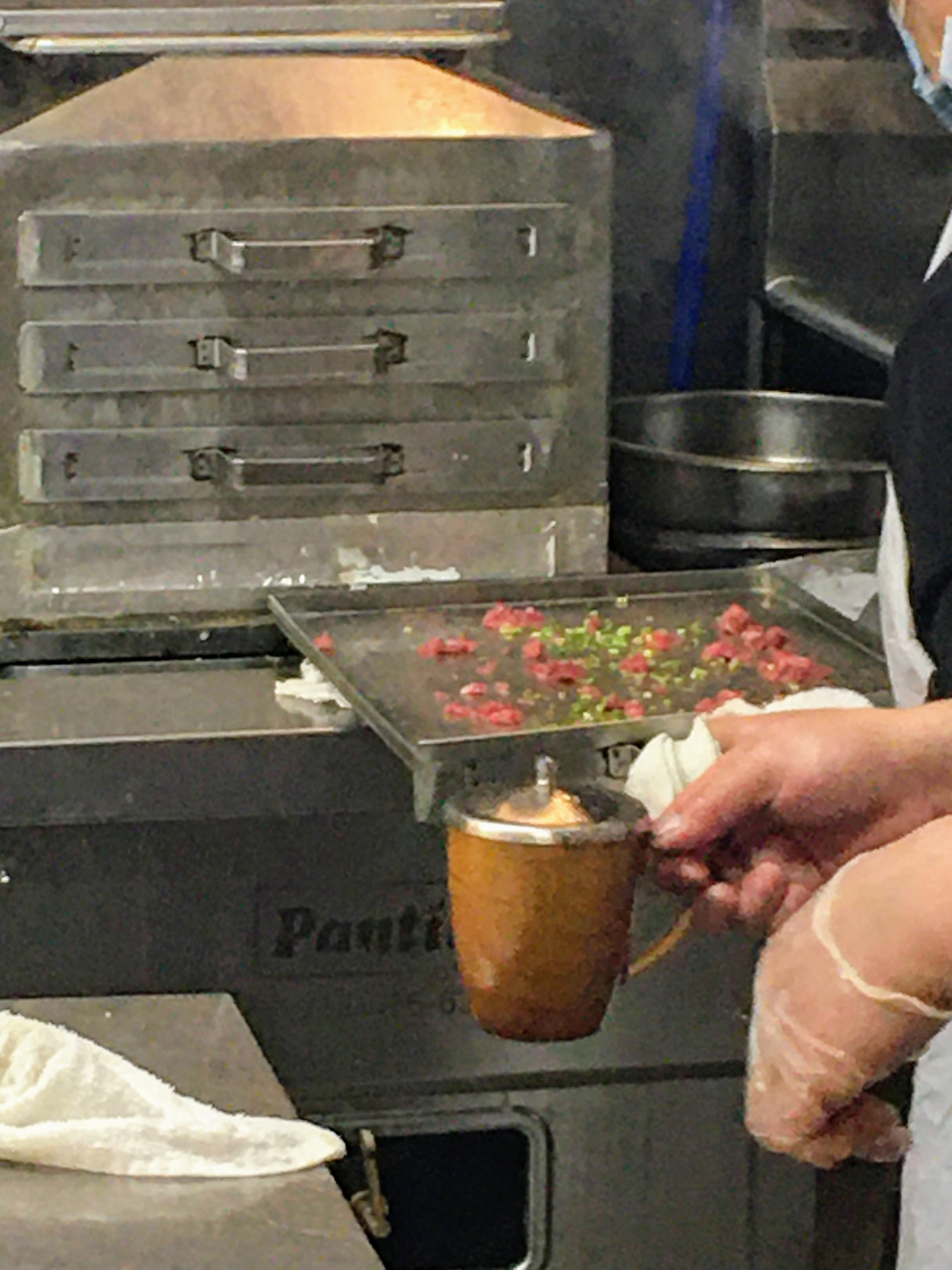
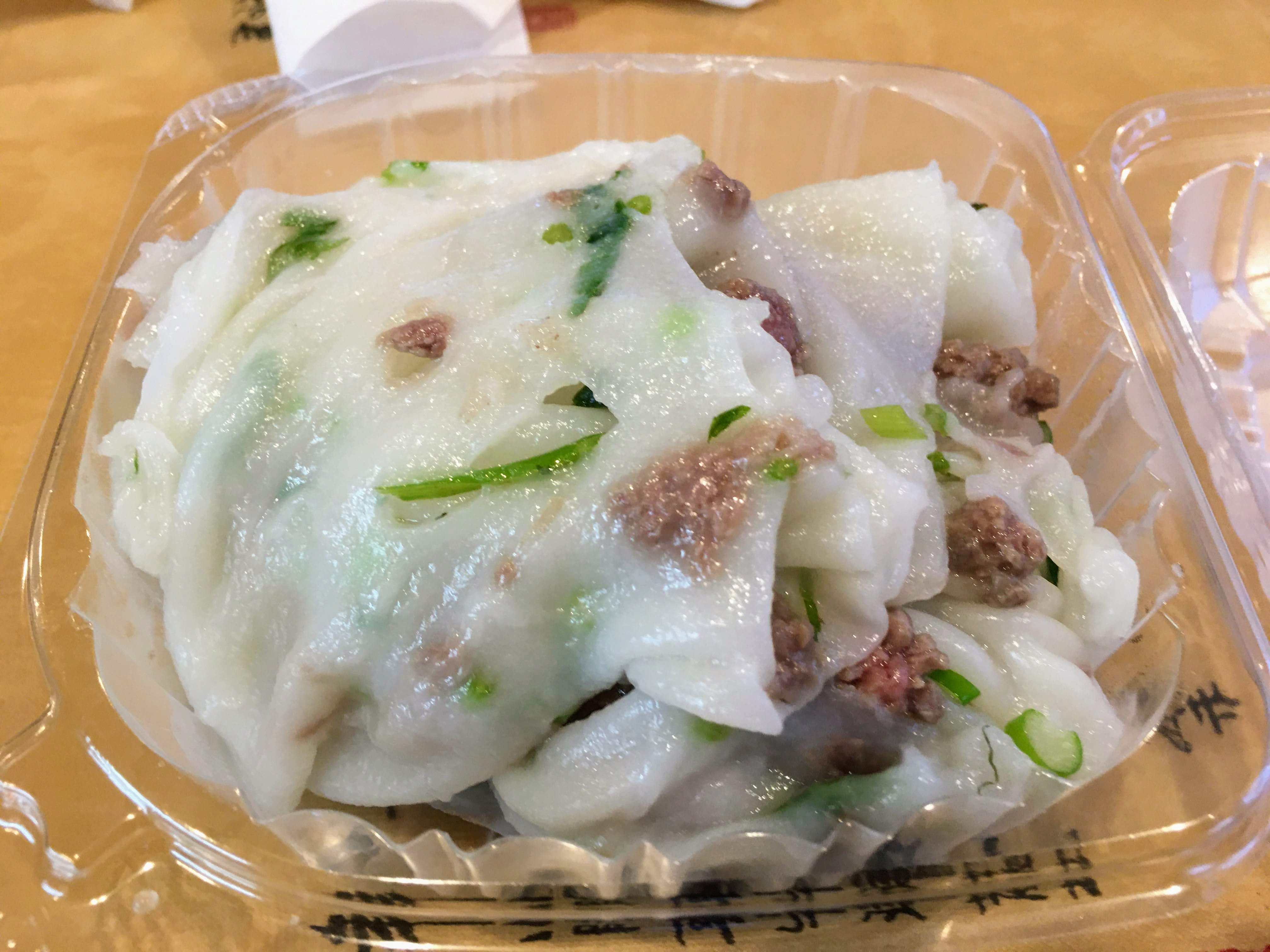
One real highlight was at Green Garden Village, where after ordering a beef cheung fun, they actually prepared it within sight!  Not an extraordinary tasting end product, but I was happy.


The problem with dim sum in Manhattan Chinatown is that most of the major purveyors, like Jing Fong, Golden Unicorn, Nom Wah and Ping's have been around forever and are short on innovation.  Even the most inventive dim sum restaurant, Dim Sum Go Go, has been around almost 20 years.  One newcomer which is not talked about, and draws a large neighborhood crowd is Seng Seafood on East Broadway.  Their fish balls compare favorably with what I'm used to in California.


And I did find a little dim sum innovation at E-Noodle Group, which serves mostly noodle soup but also has a few dim sum items.  This jade har gow looked great and tasted very good, too.


Another new restaurant was New Hong Wong on Bowery.  This was the interesting sounding eel with rice casserole.  Unfortunately the rice was not cooked enough and gave Mrs. Chandavkl extreme indigestion, though the flavor was good.


The beef chow fun was pretty good, but the noodle itself was reminiscent of the old style noodle which is a little less smooth, a little less chewy, and not translucent like the noodles we are used to.


Another new interesting restaurant was 95 Grand Master on Chrystie Street.  We were especially intrigued by the white board special outside listing carp in black bean sauce, so we ordered it for $48.  The owner said that the center section with the stomach was a favorite with all his customers, so we took his advice.  Maybe his client base liked the stomach, but we sure didn't, as it wasn't meaty.

So he offered to replace it with the tail section which was very meaty.  But while the tail was meaty, it wasn't flaky.  It was probably undercooked.  Also not terribly flavorful.

However the Chinese broccoli with lap yuk was pretty good, and 95 Grand Master might have possibilities.

One thing I had no problem with was the Chinatown bakeries.  Tao Hong on Christie St. had the best pineapple top bbq pork bun I had ever eaten, and their egg tarts are the best in New York Chinatown, too.  And incredibly it's probably the cheapest bakery in Chinatown with this bun going for $1.50.  Another amazing thing is that Tao Hong is located in the same building as Wah Fung #1, which probably makes the best mass produced char siu in the United States.  Two gems side by side on the little known Chrystie Street in Little Fuzhou, the non-touristy portion of Manhattan Chinatown east of Bowery.

Also all the sandwiches at all the Chinese bakeries, made with water roux, which makes the various pastries at the Chinese bakeries so smooth and creamy, were great.  Here's the fish sandwich from Bake Culture, the Taiwan based bakery chain on Bowery.

A chicken sandwich from New Kamboat Cafe on Bowery.    Really good baked bbq pork buns and Macao egg tarts, too.

And the best of all, the fish sandwich from Double Crispy, which also had a nice selection of pastries including raisin buns, apple turnovers and lemon buns.


All in all it was a successful trip which enabled me to get back in touch with the food scene in New York Chinatown.  While the food there isn't the greatest, having eaten at about 450 different Chinatown New York restaurants over the years, I've gained a level of comfort eating there which makes up at least in part for the lesser quality.


Tuesday, April 19, 2022

Stark Commentary On The Decline of Cantonese Food

As you may know, King Hua, one of the top tier SGV dim sum restaurants was one of the first pandemic casualties back in 2020. It was one of a succession of dim sum restaurants operating at that location dating back to 1984 and Casa de Oriente, which chose a decidedly un-Chinese name so as to not ruffle feathers in what was then still a largely white area of Alhambra. That space is now occupied by the first US branch of the Chengdu based Sichuan nightclub chain JiangHu Bistro. This really puts an exclamation mark on the shift we’re seeing in the SGV and Chinese communities all over the US away from Cantonese cuisine and to Non-Cantonese Mainland cuisines. As such I wanted to drop by to see how the premises changed from where I enjoyed so many Cantonese meals to one where I discovered myself in a red fog.


image

Tuesday, April 12, 2022

Crowds At Bafang Dumpling Are Crazy—But Partly Self-Inflicted

Bafang Dumpling recently opened on the perimeter of the Puente Hills Mall that fronts on Azusa Ave., adjacent to stores such as Starbucks and Krispy Kreme.  It's the biggest dumpling chain in Taiwan and word of its arrival created great excitement, particularly in the Taiwanese American community and leading to a mob scene on opening day.

I dropped by Bafang Dumpling, and while the excitement of the opening has dropped off, it is still quite a madhouse.  However as I learned, the mayhem is at least partially self-inflicted.  Actually I approached the store with trepidation on two separate counts.  First of all, of course, was the fear that the crowds would be unmanageable.  In addition, Bafang was profiled by EaterLA, and the article contained disturbing management comments that consistent with their location in the Puente Hills Mall street frontage, Bafang was trying to crack the general fast casual market, competing with players like Chipotle, and indeed admitting to tweaking their recipes to American tastes.  Horrors! 

However when I arrived, I was relieved that to see that the line went only to the front entrance, and that the shop was besieged by Taiwanese expats, hungry for a taste of Taiwan’s biggest dumpling chain, with nary a potential Chipotle customer in sight.

However things changed after I arrived.  It was nearly a 15 minute wait by the time I got to the front of the line to order, and when I got to my table I saw that the line had grown much longer.  And then it was at least another 15 minutes before my order was ready. This preparation gap makes no sense to me because the entire menu barely exceeds a dozen items. Famous for their potstickers and their dumplings, they only offer two varieties of each, “signature Bafang” and kimchee, which means everybody coming through is going to be ordering primarily these four items.    I did not realize at the time how lucky I was because it turns out it’s not unusual to have to wait an hour in line to order, and then another 30 minutes to get your food, which just deepens the mystery of why it takes so long to prepare your food. So with such a drawn out wait to get your food, it’s no surprise that the line to place your order is so long, and that the length of the wait is not solely due to the demand for the product.

The food itself is very good and the prices are extremely reasonable, which probably explains why so many people endure the wait. The signature Bafang potstickers are sold by the dozen and are excellent. No signs of the food having been adapted to non-Chinese tastes.


The signature Bafang dumplings are also very good, as are the signature Bafang noodles.


A dozen potstickers, a dozen dumplings and the noodles came to $25. I’d surely go back to Bafang if I didn’t have to wait in line.