Tuesday, September 7, 2021

What We Ate In Honolulu

The great thing about having foodie kids is that they can take you to great restaurants that you never would think of going to yourself.  This was doubly so if you go with them on a food eating vacation like we did with my daughter and her husband a few years ago on an eating trip to Hong Kong.  This time we tagged along as they went to Honolulu on a six day eating expedition.  Due to COVID issues and the rush for mainlanders to visit Hawaii, many restaurants were reservation only.  Upon landing on a Tuesday, and after battling our way through Honolulu Airport's COVID clearance process, we arrived late for lunch at our first destination, The Surfing Pig in the Waielae-Kahala area east of Waikiki.  It was in an interesting neighborhood with a nice mix of Asian ethnic restaurants.  Before they seated us, they took our temperatures and had us fill out what turned out to be a contact tracing form, which turned out to be a routine part of most of our restaurant visits, though this one was the most elaborate.  The Surfing Pig is part of the Kono Group, a small chain of restaurants in Hawaii which also has a location in Las Vegas.

The loco moco was terrific, as was the bed of fried rice.

The chicken waffles were also very good.


Tuesday dinner was on King St. at Sushi Izakaya Gaku, set at 5pm like most of our dinners because of baby Jemma's schedule.  Given that lunch ended after 2pm because of our airport delay, plus slow service at lunch, that left a small gap until dinnertime.  Nevertheless the dinner was great starting with the kanpachi.


 Don't remember ever eating sushi better than what was served here.

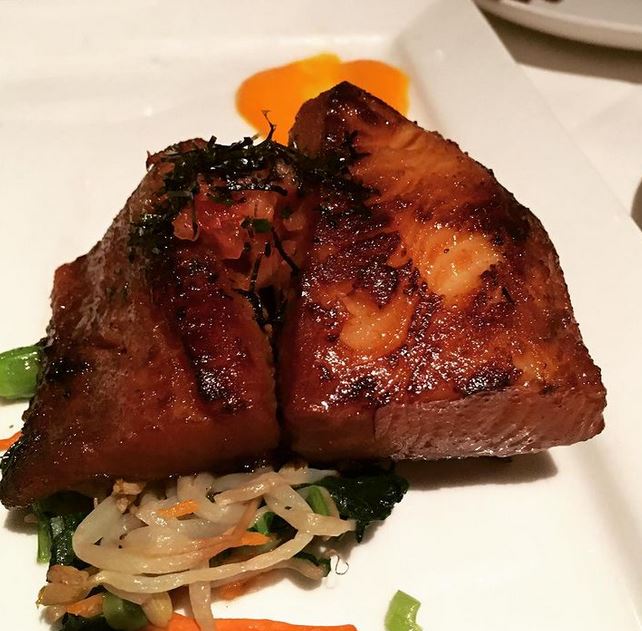
 Equally tasty was the miso butterfish.  Of course this wasn't ordinary food but the $65 per person was well worth it.


Wednesday's lunch was at Wagaya Ramen, one of the few unreserved meals on the trip.  We arrived at the restaurant early to sign in, then waited until the restaurant opened, at which time there were almost enough patrons to fill the small restaurant. This was the best of the best as far as trip meals were concerned.  The Wagaya ramen shiro was out of the world, even better than Tsujita in Los Angeles.  


And the tempera corn appetizer was certainly something we've never seen.


At dinner time we drove to the nearby Tonkatsu Ginza Bairin, which was reserved two months in advance, for their signature Kurobota pork tonkatsu.  They only prepare only 10 portions of this dish every day, so it pays to reserve an early table.  Frankly, the tonkatsu was great, but the Kurobota pork loin was too fatty for its own good.

The regular pork tonkatsu platter was actually much better.  


After dinner we headed to Ice Monster, the only US branch of the Taiwanese shaved ice chain, which we had been dreaming of since our November, 2019 trip to Taiwan, and in my pre-trip scouting had discovered was only 250 feet away from the Hyatt Centric where we were staying.  Ice Monster's shaved ice is unique since it is made from a block of ice that already has the flavoring infused.  Better than Matsumoto's north shore ice.   The mango and strawberry ices were a hit with everybody.


Thursday's lunch was a short drive away at Jade Dynasty in the Ala Moana Shopping Center, my designated Chinese restaurant for the trip.  We started off with their crispy baked bbq pork buns, which were hot out of the even and as good as anybody's.  

The rest of the dim sum was passable by San Gabriel Valley standards, with the deep fried green shrimp chive balls being the most interesting.  


The seldom seen scallop cheung fun were just ordinary.

Another seldom seem variety, deep fried fish balls, were quite good.

Jade Dynasty may have overdone it with the deep frying, as I did not expect the tiger shrimp bean curd rolls to be deep fried.  Not that they were bad.

Likewise Jade Dynasty's Seafood Corn Pancakes were deep fried.


Thursday night was our night to babysit Jemma so we went to find ramen for Jemma to eat around the hotel.  This turned out to be more difficult than anticipated.  The ramen stall at the Kuhio Food Hall in the International Marketplace (now an upscale shopping mall rather than the outdoor bazaar it used to be) never reopened from the pandemic.  Then there was the Japanese food court across the hotel on Seaway, but that entire operation shut down, too.  Apparently while Waikiki seemed as busy as always, most of the current tourists are domestic, with few international tourists from Japan who would be looking for ramen.  Fortunately, a clerk at one of the stores mentioned a ramen place in the Royal Hawaiian Shopping Mall which I had visited earlier in the week while scouting out the local branch of Tim Ho Wan, so I was able to kill two birds with one stone.  However, the ramen from Kazan Ramen Express wasn't very good.


I am definitely not a fan of the US branches of Tim Ho Wan, which aside from their signature crispy baked BBQ pork buns has nothing else on the Manhattan or Irvine branch menu that approaches what you get in the Hong Kong locations of the restaurant.  Of course there are always the crispy baked BBQ pork buns, so I was certainly looking forward to these.  While good, strangely I found myself slightly preferring the similar item from lunchtime at Jade Dynasty.  No complaints though.


I had heard that the Tim Ho Wan lava custard buns were pretty good, too.  So never having ordered that dish previously, I decided to try it.  It was quite good, though there are a lot of Chinese restaurants that make this dish as well or better.


The real surprise was the char shu chow mein which I ordered basically just to complete the dinner order.  It was actually quite good, with the highest quality cha shu I've had in that dish.


Friday's lunch was scheduled for Marukame Udon's original Honolulu branch, and since this was a stand-in-line restaurant we planned to arrive at 10:45am and wait in line.  Leaving the hotel at 10:25am, I decided to check out the location first just to see exactly where it was, before walking around the area.  That was a lucky decision because as we walked by there were already three dozen people in line, so we jumped in right away.  By the time the restaurant opened at 11am there were probably 80 or more people in line.  Though we had not been overly impressed by the Los Angeles area branches, the udon at Marukume in Honolulu was great and well worth the wait.  Both the regular beef and curry udon were fantastic. 


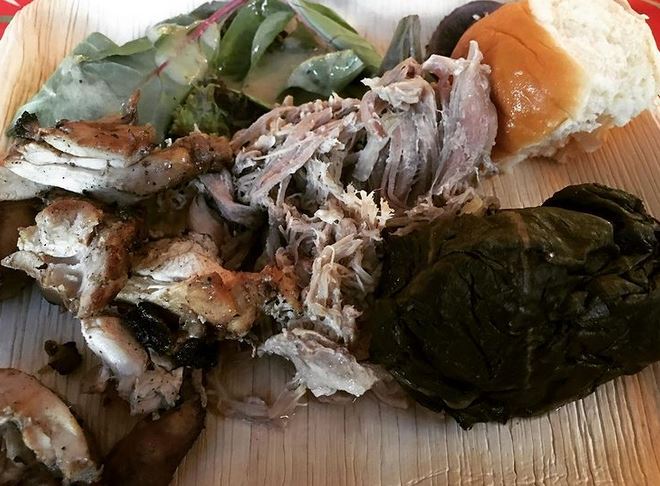
Friday's dinner was early because it was a late afternoon luau at the Experience Nutridge, at the Nutridge Estate on Round Top Drive in Honolulu.  We arrived late at 4:30pm, but did arrive in time for the official start of the event.  They had shows and demonstrations which were very interesting, with tales of wild pigs eating everything in sight and having to protect the macadamia nuts with metal wraps on the tree trunks.  Menu was short but very good with pulled pork, bbq chicken, Lau Lau, sweet rolls and coconut jelly highlighting the dinner.  From what I was told thus was unusually good quality food for a touristy luau.


Saturday was a pleasant surprise for me because while there were no Chinese meals planned for the trip except Jade Dynasty, both meals ended up being in Chinatown.  Lunch was at a Korean fusion restaurant called O'Kim's Korean Kitchen.  Waiting for food to be served I took a quick walk to Hotel St. and Maunakea St. in hopes of finding a shop selling manapua, the Hawaiian version of a baked bbq pork bun, slightly different from what we get here.  I did quickly find Bread House, but unfortunately they were sold out of manupua so I had to settle for a coconut tart.  Interestingly this picture received more Instagram "likes" than most of my non-Chinese food postings.


O'Kim's had an interesting menu.  This was the Korean fried chicken with gnocchi nuts.

This was the pork belly confit.

Kalbi beef.

Surprisingly the best entree was the unassuming looking seaweed salmon.

But the real highlight was corn on the cub which really wasn't, but rather corn ice cream made with a mold that looked like corn on the cob.


For dinner we headed back to Chinatown and Lucky Belly, literally around the corner from O'Kim.   Lucky Belly had an interesting complement of appetizers with the signature dish being the oxtail dumplings.


 Personally I was more partial to the crispy duck tacos


The pork belly buns were a decent version of gua bao.


Here's the lobster siu mai.  


I thought all the appetizers were better than their signature monster ramen bowl with brisket and oxtail won ton, which was pretty good though. 


Sunday lunch was at a Vietnamese restaurant, Piggie Smalls, the second branch of the acclaimed Vietnamese restaurant in Chinatown, The Pig and The Lady. The main attraction as Piggy Smalls was the french dip pho, a brisket on a french roll, with the dipping sauce being a flavorful pho broth with optional pho.  Certainly an innovative and delicious dish.  

 The giant chicken wings looked better than they tasted.  


Since this was our last full day in Honolulu, I wanted to find a li hing/crackseed store before going home, if I could.  As it turns out, the only one anywhere close to the hotel turned out just a block away from Piggy Smalls.  So after lunch it was a quick walk to Lin’s Hawaiian Snacks which was full of products like li hing gummy bears, powdered li hing, mui, ginger and other dried snacks.   


And just a half block away was It's Tea, which had some interesting flavored drinks including lilikoi green tea and pineapple Earl Gray.


Dinner was at Roy’s, which was much better than the Mainland branches.  Dinner started with an absolutely fabulous appetizer, particularly the ahi poke tuna, shown here with the Hong Kong crab cakes.


The salmon, and macadamia crusted catch of the day were quite good.  But by far the star of the show was the signature misoyaki butterfish.  The most delicious fish dish I have ever eaten.
However the recommended mochi crusted catch of the day was entirely ordinary.  A real disappointment and it's hard to figure out why it was recommended so highly by the waiter.


Since it was my birthday earlier in the month I was rewarded with this birthday dessert.

All in all a great meal at Roy's, though probably not worth the almost $100 per person.


Last food in Honolulu before flying out Monday was ahi poke from the Coco Cove store on Kalakaua Ave.  First, spicy.

Then non spicy, much better.

And don't forget snacks on the plane from the imaginary Pau Hana Cafe, the brand name used by Hawaiian Airlines for their onboard food.  Hey, any free airline food on a domestic flight is appreciated.


Friday, August 27, 2021

Chinese Restaurant Mysteries Part III - Ace Burgers

Since it's been almost exactly 10 years since I've written up a Chinese restaurant mystery dealing with a puzzling Chinese restaurant event the time is ripe for another such article which just solved itself.   One year ago, Tianjin Feng Wei opened up on Valley Blvd. in Alhambra in the depths of the pandemic, one of  perhaps just a handful of new Chinese restaurants that opened up in the San Gabriel Valley after the pandemic hit late last winter.   Any new Chinese restaurant opening at that time was puzzling, and Tianjin Feng Wei's opening was doubly puzzling because they opened up in an abandoned restaurant storefront that had been vacant for five years, and known as a graveyard for Chinese restaurants with 10 different Chinese restaurant occupants over the years.  

As it turned out, Tianjin Feng Wei was a gem.  Their Tianjin style pork buns were fantastic and raved about by online commentators.  Their beef bing was excellent, not as good as the version at Beijing Pie House, but when Beijing Pie House failed to survive the pandemic Tianjin Feng Wei became a go-to source for beef pies for many people.  And a number of their other dishes were excellent too.  But then suddenly this past March there was a notice that the restaurant would be temporarily closed for a week.  Fine, it's not unusual for small restaurants to go on vacation.   But upon reopening a week later, while the building signage still said Tianjin Feng Wei, the sign in the window and the menu now said Ace Burgers!  

Of course Chinese restaurants get sold all the time, quite often with a new name and a new style of cooking.  But in this case the quick flip of a popular new restaurant was unusual, as was the speed in opening the new style restaurant.  The latter was quickly explained by the fact that the restaurant was not sold, but merely rebranded by the owner with an entirely different menu.   So the change in cuisine could just be a business decision that the new menu would be more successful than the old one, though that didn't seem to be probable, since they had the only Tianjin pork buns in town.  And adding to the puzzle was the fact that Ace Burgers did not sell burgers.  Rather, the new menu consisted of chicken sandwiches and fried chicken.

Fortunately all this has just been explained by social media stars the Fung Bros in their new video on latest food trends in the San Gabriel Valley, and who once were so nice to refer to me as the "OG Chinese foodie" (whatever that means.)   As it turns out, McDonald's in China has created a spicy chicken sandwich which is the rage of not only China, but all throughout East Asia.  Likewise, KFC has created a similar product with their spicy chicken wings.  Consequently, Ace Burgers has a menu that strives to duplicate the popular chicken dishes served by McDonald's and KFC in China.  And why the name Ace Burgers if they don't serve burgers?  Because in China, chicken sandwiches are known as chicken burgers.  And now the flip to Ace Burgers makes perfect sense.


Sunday, August 1, 2021

Guide To My Video Appearances (Revised May 2026)

Recently I thought it would be a good idea to have a central location for the various video appearances I have made during my Celebrity Diner period.  However that goal proved more elusive than I had imagined as a combination of technical issues and copyright law prevented the use of any single hosting site for the videos I wanted to post.  It took a combination of YouTube, Facebook and Dailymotion postings to find a home for the videos I wanted to upload.  Consequently, this write-up turns out to be the one-stop repository I wanted, providing the various links to the uploaded videos.

Goldthread Video Documentary Interview With Clarissa Wei. Back in 2012 when Clarissa Wei did her LA Weekly article about my Chinese restaurant list that went viral around the world, I figured that was the lightning strike that gave me my 15 minutes of fame.  Surprisingly I received an unrelated additional 15 minutes of fame the next year where Frank Shyong wrote his Los Angeles Times Page One article on my Chinese restaurant eating adventures.  And in 2014 there was a third 15 minutes of fame when I appeared in the Chinese food documentary, The Search For General Tso.   As a result of these three episodes I had reached a comfortable level of recognition in the Chinese food journalism community such that I could write my own articles related to Chinese restaurants in America and occasionally be contacted by food journalists for interviews and quotes.  In 2016 I received a message from a budding filmmaker named Sarah Coakley who thought my story was interesting and wondered if I would be interested in being the subject of a short film documentary.   I was a bit dubious and a quick search did show film industry connections, though no projects of her own.  I never received any followup and I don't think she ever actually produced anything, but that was OK with me since I had already experienced more time in the spotlight that I had ever dreamed and being the subject of a documentary seemed far fetched.  Little did I know that the biggest and best was yet to come.  

In late 2018 I was contacted by Clarissa Wei, who was now a senior producer for Hong Kong's South China Morning Post English language daily newspaper's video arm called Goldthread 2.  She said she would be coming for a visit back to Los Angeles to shoot a few short videos and thought it would be nice to do a sequel to her 2012 interview with me on a different medium for a different audience.   That sounded interesting and fun, so I met her in February of 2019 in the San Gabriel Valley and we shot scenes in Monterey Park, San Gabriel and Temple City.  After two months of post-production work, Goldthread released the video in April of 2019 and it was an immediate hit under various titles including "Obsessed" and "The Restaurant Collector."   I had all of 500 Instagram followers at the time of release, a number I was quite proud of since I really hadn't done anything to promote a following.  Within two weeks of the Goldthread release, the number jumped to 1,500 followers.  And mind you it's not like there was a link or anything from the Goldthread video to my Instagram page.  These people had to track down my Instagram page to follow me.  But perhaps the bigger surprise was that the video has gone through waves of new viewers in the ensuing four years.   The video has now been viewed 1.3 million times on various platforms.  Surprisingly the number of YouTube viewings has been a relatively small portion of the total, only 40,000 views at the time of release, and another 200,000 plus views in 2021 when the video broke into YouTube's autoplay rotation for several weeks.  Rather, the bulk of the viewings have been on Facebook, where the original Goldthread posting has been supplemented by several discussion thread links posted by members of the powerhouse Facebook group Subtle Asian Traits and its nearly 2 million members.  As a result, the repeated viewings of the video raised my Instagram count to over 3,600 by the fall of 2021.  (Subsequent exposure on BBC, noted below, raised the Instagram count to 17,000.)  Oh, and this is essentially the documentary about me that didn't get made in 2016.  The Goldthread video can be found on YouTube here.  https://www.youtube.com/watch?v=bMuSEuuZTeM

The Search For General Tso.  While nobody has told me directly, I presume I was interviewed for the Chinese food documentary The Search For General Tso because of Clarissa Wei's 2012 print article.  My recent blogpost Me And General Tso capsulizes my involvement with the movie.  Uploading a copy of the movie proved to be an extremely daunting task and being successful was nearly miraculous.  The first issue was finding a digital copy of the movie.  Surprisingly there were numerous postings purporting to let you see the movie for free, but they were all scam sites designed to get you to download suspicious software.  The biggest miracle was finding the movie online with no strings attached.  Of course, that was only part of the solution since the copyright police is always on patrol, so while the movie might be here today it could be gone tomorrow.  So the next issue was making a copy of the file.  Fortunately I have software that captures streaming video and it was able to download the movie.  But uploading the movie was also a big challenge.  Due to various limitations, running from copyright filtering to file size limitations, YouTube, Dailymotion and Vimeo could not be used to park the video file.  However, I discovered that Facebook was one site that allowed the upload of large files, and I posted it here.  https://www.facebook.com/Chandavkl/videos/10158826336196477

WHYNOT-WAINAO Melting Wok San Gabriel Valley interview.  This was deja vu all over again as I reprised my walking tour/sit down Chinese restaurant format as in the Goldthread and Hong Kong Daily Apple News videos with some overlap in locales.  Actually, I met with producer Rachel Chen from Washington DC after receiving an email addressed to "Mr. David Chandavkl" in Los Angeles Chinatown September of 2022 at Pearl River Deli to discuss the premise and logistics of the video shoot for the Los Angeles segment of what became the Melting Wok videos.   The return visit for the video shoot was originally scheduled for December of 2022, but then postponed until April of 2023, when I was interviewed by Taiwanese American food personality Tzu-i Chuang Mullinax.  With an extended post-production period, the video was released on the day after Christmas in 2023.   https://www.youtube.com/watch?v=yrIJjU3hpjk

Warner Bros. Family Style Chinese Buffet Episode.  The background on how I became a Warner Bros. cartoon character in 2020 sharing billing with actor/comedian Jimmy O. Yang (whose last name really is Auyang) are in my prior posting describing the production of the Stage 13 video.    https://www.dailymotion.com/video/x7wezh6   Because of the HBO/Warner Bros. affiliation, it was streamed on HBO Max for a period of time.  Technically that made Family Style a TV show and theoretically gives me a television credit.  Note that when HBO Max became the sole outlet for the show the former links to YouTube and the Stage 13 websites became inactive.

Los Angeles Times Off Menu.  Another video with hundreds of thousands of views was the one with Los Angeles Times food columnist Lucas Kwan Petersen in 2019 where I described how historic housing discrimination against minorities in Los Angeles led to the establishment of a giant suburban Chinatown in the San Gabriel Valley.  Fortunately my segment is at the front end of the video. https://www.youtube.com/watch?v=sEghvcaBi5c

BBC World News Television Interview.  Companion piece to a written English language article on the BBC website in November of 2021, which had been preceded by a BBC article in Chinese, the interview probably reached the greatest audience of anything I had been involved with.   The content was not wildly different from past articles and interviews but being on BBC was an unprecedented platform, constituting an unexpected fifth strike of lightning, and an overnight addition of 13,000 additional Instagram followers.  However, this televised interview was really secondary to the website article, which became the most viewed item on the BBC site, and which led to a hastily arranged live appearance on BBC World News on Thanksgiving Day. https://twitter.com/i/status/1464073116280229890

Hong Kong Daily Apple Video Documentary Interview.  Essentially a Chinese language recreation by the Chinese language Hong Kong Daily Apple newspaper of Clarissa Wei's 2018 video, shot in late 2019 with Daily Apple reporter Gabrielle Chang before the pandemic and modified and released in the fall of 2020 to reflect the effect of the pandemic.  Note that with the government shutdown of Hong Kong Daily Apple the original article and video are no longer online on any Daily Apple website, but if you want a PDF copy of the article please contact me. The video is at https://www.dailymotion.com/video/x7wp6ya

China Global Television Network.  In one way this is the most flattering video involvement for me, part of China Global Television's Tso'l Food hosted by Gerald Tan.  The premise of this series is to show viewers Chinese food from communities around the United States.  When I was contacted by the show they had only done episodes from Washington DC, where China Global has their United States headquarters.  When they asked me whether I would be available to do an interview with them, I assumed that Los Angeles was their next stop on the map, since Los Angeles has the best Chinese food in America.  However during our video shoot in Los Angeles, he told me that he and his crew planned their visit to Los Angeles only when I accepted their invitation to appear, and if I had not accepted they would not have come to Los Angeles!  https://www.facebook.com/watch/?ref=search&v=605895503889419&external_log_id=969dedb8-2424-476e-a7d8-b39dda86fd99&q=tsol%20food 

Subsequently, a separate Tso'l Food Los Angeles episode was released on Chinese New Year's Day 2022 in which I do an introduction for each of the businesses visited. https://www.youtube.com/watch?v=9Jy0EQcInoE

Interview with Australian Channel 7.  Appearance in the wake of Clarissa Wei's original print article.  Little did I know that Australian Channel 7 had a TV studio in Century City, three blocks from my office at the time, and which is where I was interviewed by the Australian hosts.  Some background on that live TV broadcast  which occurred at 5pm Friday afternoon in Century City but was around 7am in Sydney are in my prior posting.   https://www.dailymotion.com/video/x7vulrr

Chinese Historical Society of Southern California video program.  In May 2026 I gave a Zoom presentation "How Los Angeles Rose From Oblivion To Become The Chinese Food Capital of the United States."  Here's the YouTube replay.  https://youtu.be/d42ncHl8rw0

TriBeCa Film Festival Appearance.  In connection with the premiere of The Search For General Tso at the 2014 TriBeCa Film Festival, I was part of the post screening Q&A. An interesting sidebar to this session was that when director Ian Chaney called me onstage to participate in the Q&A I figured I would be basically a stage prop with all of the questions directed to Chaney.  So as soon as I got on stage I wanted to get my two cents in right off the bat and thanked Chaney for creating a film that went beyond the food history and told "our story," i.e. of discrimination and abuse faced by the Chinese in America.  Imagine my surprise when some time later when the General Tso movie went into release, I came across an interview with Chaney where he described his nervousness at the start of the Q&A at TriBeCa, presumably because he didn't know what the audience reaction to his film might be, and he specifically recounted how my opening comment had put him at ease as it validated what he had done. This 30 second clip gives a flavor of what it was like.  https://www.youtube.com/watch?v=xo-oh1_tDjo

KCET Asian Food and Culture Show.   In 2013 I appeared on a KCET special highlighting Asian foods and cultures along with Clarissa Wei.  It was kind of dumb in that it discussed Asian food in Los Angeles, but Asian culture in Asia as highlighted by excerpts from episodes of the Globetrekker TV series.  I was on the set (Lunasia Restaurant in Alhambra) for several hours for just a couple minutes of air time as described in this prior post, and lost my copy of the video when my TiVo crashed.  All I have is Clarissa's video of my Chinese restaurant list, and a shot of Clarissa's television showing the program.  https://www.youtube.com/watch?v=5qy_yajF1K0


Closing of Chinese Friends Restaurant in Los Angeles Chinatown.   Right before Chinese Friends Restaurant ended its 50 year run in 2022, I received a call from the Los Angeles Chinatown business group asking if I wanted to have one last meal there.  Little did I know that they were doing a video on the closure and asked me about the significance.  https://www.instagram.com/p/Ch0GKDujAvf/


USC Annenberg School of Journalism Video.  I make a brief appearance in this short video on the evolving nature of Los Angeles Chinatown.  https://www.facebook.com/521061476/videos/1458525189407743/ 


Third party video based on Frank Shyong's Los Angeles Times profile of me.   As a celebrity diner I've gotten a far more detailed look at some very strange things on the internet that most people are not aware of.  One is this video which was inspired by the 2013 Los Angeles Times column one article about me.  It is a high quality, polished video which starts with a mention of the article, then throws in a movie clip of Ashton Kutcher ordering Chinese food, followed by a bunch of related and unrelated topics.  What the ....?   https://www.dailymotion.com/video/x9re8le

Robot reading BBC article about visiting almost 8,000 restaurants.   If the previous video above wasn't the strangest one of the bunch, the YouTube video of a robot reading the BBC English language article about me certainly is.  Perhaps if the robot were sophisticated and could pick up the nuances of the English language this would make sense.  But it doesn't.  https://www.dailymotion.com/video/x867nla

Followup Goldthread Video.   My subsequent appearance on the Goldthread show plugging Clarissa Wei's Goldthread documentary.  You have to skip to about the 31 minute mark to find me.  https://www.youtube.com/watch?v=9mOVc1Hrvho

It Takes All Kinds.   Before becoming a celebrity diner, there was a period of about 10 years where I made public appearances on behalf of the Chinese Historical Society of Southern California, including a show on the CBS television station Los Angeles, then known as KNXT, called It Takes All Kinds.  This was in 1979, back in the day where the federal government required all commercial television stations to broadcast some minimum amount of public service programming to maintain their licenses.  I appeared on an episode dealing with ethnic communities in Los Angeles.  https://www.youtube.com/watch?v=0KG2lZEAMl4


Thursday, July 1, 2021

Critics Of Los Angeles Chinatown's Food Revival Get It Wrong

In a lengthy well written, thought provoking article posted yesterday on Eater LA, writer Cathy Chaplin addresses the intersection of the food based revival of Los Angeles Chinatown and the impact of this development on the existing community.  In particular it focuses on an organization called Chinatown Community for Equitable Development (CCED) which chides the influx of new, independently owned eateries and other businesses into Los Angeles Chinatown for failing to address the inequities taking place on their new home turf.  This viewpoint was contested by one of the new business owners, who operates Oriel, a French wine bar, who said “Is Oriel displacing anyone? I mean it was a dilapidated building, which is being broken into and having homeless encampments, so it seems like a better use to me.” 

The problem with the position taken by CCED is that it is completely oblivious to the history of Los Angeles Chinatown.  Los Angeles Chinatown started dying decades ago when the San Gabriel Valley emerged as the magnet for Chinese Americans and other Asian Americans.  When was it when I started to feel uncomfortable in Chinatown after dark because there was little activity and the streets were dark? 30 years ago? 40 years ago? Certainly well before the time that any of the CCED members have personal recollections.  How many years did Chinatown go without any new construction?  I mean nobody is going to build anything in a dying community.  There was no way Los Angeles was going to remain a vibrant, complete Chinese community. It’s revival has been awesome.

And unlike San Francisco, Manhattan, or even Philadelphia, Boston or Chicago, Los Angeles Chinatown is not an historic one.  Historic Los Angeles Chinatown was torn down in the 1930s so they could build the new Union Station railroad terminal.  In its place "New Chinatown" on Broadway was constructed in the late 1930s to replace Old Chinatown.  (While not totally obsolete, references to "New Chinatown" today are definitely disappearing.)  Except that New Chinatown did not replace Old Chinatown as a community.  Rather New Chinatown was effectively one of the pioneering theme parks of Los Angeles, featuring curio shops, wishing wells, restaurants, the organ grinder with his monkey, and other tourist activities, but nearly devoid of Chinese residents (who largely moved to residential areas adjunct to the Chinese dominated City Market wholesale produce terminal) or everyday businesses.  New Chinatown comprised the area sometimes referred to today as Chinatown Plaza, and the southern boundary of New Chinatown was College Street, meaning that there were no streets with vehicular traffic, just pedestrian walkways with street names such as Gin Ling Way, Mei Ling Way and Sun Mun Way.  Anything in what people consider Los Angeles Chinatown today that was south of College Street was either not Chinese (quite possibly Italian), or if you headed south to Ord Street or Spring Street, a separate Chinese area that was an extension of the original Old Chinatown.  So it's no surprise that my family seldom visited New Chinatown in the 1950s, 1960s and early 1970s and I have very few recollections of the area.

Things changed drastically in the late 1960s as the effect of the 1965 immigration laws which effectively raised the annual immigration quota for people of Chinese descent from 105 to 20,000 took hold.  Los Angeles Chinatown saw an influx from new immigrants from Hong Kong who piled into the residential areas west of Chinatown.   Restaurants offering modern Cantonese food from Hong Kong livened the food scene.  Meanwhile, the physical gap between New Chinatown and the Ord Street/Spring Street was filled with Chinese commerce, creating the geographic Chinatown community that we know of today.  

Los Angeles Chinatown boomed in the 1970s and early 1980s, generating a never before seen level of activity, with new construction, new restaurants, and a completely new vibe.  We joined the crowds on Sunday morning waiting to get into Grandview Gardens for dim sum and cheered every new Chinese restaurant that opened, especially the opening of the complex unofficially known as Food Street, now known as Far East Plaza, and present home to eateries like Pearl River Deli and Howlin Ray's.  


But the boom didn't last that long.  With renewed immigration from mainland China years away due to the lack of diplomatic relations between the United States and Mainland China, the initial wave of post-1965 Chinese immigration originated in Hong Kong and Taiwan, and the Taiwanese never showed up in Los Angeles Chinatown.  While new Hong Kong immigrants felt comfortable in Los Angeles' Cantonese speaking Chinatown, such was not the case with the Mandarin speaking Taiwanese migrants.  So they headed to Monterey Park where growing Chinese American and Japanese American communities were sprouting.  Chinese and Japanese Americans had been relegated by segregated housing patterns largely to neighborhoods in South and East Los Angeles.  But around 1960, new residential communities were developed in Monterey Park by real estate developers who were willing to sell houses to Chinese and Japanese Americans.   And by 1970, there were already 2,000 Chinese Americans living in Monterey Park.

Of course the changes did not occur overnight.  Monterey Park did not get its first authentic Hong Kong style restaurant until 1975 or a banquet sized Chinese restaurant until about three years later, so Los Angeles Chinatown still remained the dominant Chinese community for a while.  Meanwhile major Chinese restaurant openings continued in Chinatown with the 1975 opening of Miriwa (and the first dim sum carts in Los Angeles), the 1979 opening of the Food Street complex and the 1984 opening of ABC Seafood.  But then the axis turned, in my opinion in 1986 when ABC Seafood opened its gigantic Monterey Park sister restaurant NBC Seafood. 

Whether the key date was 1975, 1978 or 1986, or likely no particular year, it's clear that the San Gabriel Valley sucked the life out of Los Angeles Chinatown as it became the center of Chinese activity in the Los Angeles metro area.  The large restaurant space in the front of Food Street turned into a bank. In the 1980s and 1990s many Chinese Angelinos started denigrating Los Angeles Chinatown as being a Vietnamese, not Chinese enclave.  A generation of Chinese Americans has grown up in the San Gabriel Valley, many of whom have never set foot in Los Angeles Chinatown.   There was no direction for Los Angeles Chinatown to go but down.

So it's not like today's new eateries and stores, whether modern Asian or not Asian at all are encroaching on hallowed ground.   To the contrary, they have revitalized something which would not have revitalized organically.  It's sad to see these merchants berated for something for which they should be praised, because otherwise we would end up like Washington DC Chinatown.  In Washington DC Chinatown, every business is required to include Chinese language signage for their business.  So, for example, the Chinese name for Hooters Restaurant there translates to "Owl Cafe".  But Washington DC Chinatown also has one street referred to as "Chinablock."  That's because that block is the only thing Chinese left in Washington DC Chinatown.  At least we have a Chinatown which is still relevant to myself and many other Chinese Americans.


Tuesday, June 1, 2021

The Lost Television Appearance

One television appearance I have little record of was a TV show done in the fall of 2013 called Asian Communities. I did TiVo the recording when it appeared on the air in early 2014, but that machine later crashed and the recording was unrecoverable.   In any event that was no great loss as my appearance was hardly worth it except for the fact that it provided interesting insight on how TV shows are made.  This was a segment of an irregular series that KCET used to air called Global Communities, a spotlight on LA ethnic communities.  Clarissa Wei and I did the taping at Lunasia Restaurant in Alhambra, where we sat for four hours.  I'm not sure if our total air time was 5 minutes.   So why did it take four hours to get a brief amount of air time?  First they ran late at their previous venue.  Then there was a union mandated one hour lunch break, which the technicians couldn't waive even if they wanted to (which they did because they were running late).  Then we'd reshoot scenes over and over, which was very confusing because it made it difficult for me to back reference anything I previously said since it was hard to remember how the previous segment ended up.  One really odd thing was that even though this show was seen only on KCET in Los Angeles, the hostess. Angela May, was flown in from New York.  And while I met with the show directors during the week to go over what they would be talking about, I didn't meet the hostess until I got to the restaurant.  It was only then that she was briefed on what the interview would cover.  So the gal was in reality like an actress reading her lines. Meanwhile, the segment producer who did the pre-interview legwork, a gal named Alice Robertson, turns out to be a "model, actress and archaeologist" who hosted a TV show on the History Channel.  And the old guy who was the production assistant had one acting appearance in addition to dozens of TV production credits. And the final show itself was disappointing because half the show was inserts of Globetrekker segments shot in Asia, having nothing to do with LA.  The only good things are (1) it's a credential to say I was on KCET, and (2) they asked me to bring a print out of my restaurant list and the hostess flipped through it at the start of the interview.


One other point is that even the most sparsely watched TV shows do have an audience, and in fact a while later one family friend mentioned that she had seen my appearance.  That reminded me of my first TV appearance back around 1978 on a public service show (at a time when the FCC mandated a minimum hours requirement for TV stations to broadcast such shows) on KNXT, Channel 2 in Los Angeles.  On that show called "It Takes All Kinds," for the episode on ethnic groups in Los Angeles, I was interviewed by Truman Jacques and Patricia Stich as a representative of the Chinese Historical Society of Southern California.  Since this show was required programming, I'm sure the ratings were negligible.  The show aired early on a Saturday afternoon, and when I got back into the office on Monday morning, one of the guys said he saw my appearance.  It seems that he was having his TV repaired at the time and the repairman was flipping channels and there I was!

Sunday, May 2, 2021

HURRAY FOR HOLLYWOOD Chinese Food

As I had written many times, until quite recently Chinese restaurants in the Los Angeles had been marked by the presence of good, authentic Chinese restaurants being located in a small number of specific regions, originally Los Angeles Chinatown, and subsequently locations such as the San Gabriel Valley, with wide expanses of the region being a total wasteland for Chinese food.  Changing demographics have removed some areas being reclassified out of wasteland status, most conspicuously the Westside of Los Angeles, whose transition was aided by the influx of Mainland Chinese students attending school at UCLA.

When we moved into the Hollywood Hills some 30 years ago, Hollywood was one of the most barren wastelands when it came to Chinese food, not surprising since there were very few Chinese residents in the area. I remember that when we arrived, the closest Chinese restaurant to our house wasn't even identifiable as a Chinese restaurant when you drove or walked by.  It was called The Inn Place, on the corner of Bronson Ave. and Franklin Ave., one of the subcategories of Chinese restaurants where somebody buys an existing restaurant and doesn't bother to change the name even when converting the restaurant from non-Chinese cuisine to Chinese fare.  (How else can you explain Chinese restaurants with names such as O'Toole's Roadhouse or Bavarian Gardens?)   From what I can tell, The Inn Place was previously a soul food restaurant before turning into a Chinese restaurant.  It touted itself as a Mandarin and Szechwan restaurant, the type that sprang up beginning in the 1970s serving new wave non-Cantonese Americanized dishes like hot and sour soup, kung pao chicken, mu shu pork, and double cooked pork.   But it also served old time Cantonese Americanized dishes like egg foo young, egg drop soup, shrimp in lobster sauce and paper wrapped chicken.  I know I only ate there once back in 1991, and I have no idea what I might have ordered.

Over the next 25 years I ate at several dozen Chinese restaurants in Hollywood, all aimed at tourists or local denizens.   There was actually one pretty decent place that was on Cahuenga Blvd. in the early 1990s called Diamond Seafood and BBQ, but it didn't last very long.  One whose memory sticks with me was a place called Lam's Kitchen, I believe on the corner of Hollywood Blvd. and Wilcox Ave., with the most awful chow fun ever, seemingly merely soy sauce poured over chow fun noodles that had not been fried.  

Unlike areas like West Los Angeles, Pasadena, and Thousand Oaks where demographic changes have spawned the opening of numerous authentic Chinese restaurants, no such movement has taken place in Hollywood.  Consequently I was stunned five years ago when ixlb Dimsum Eats opened up on the corner of Sunset Blvd. and Bronson Ave., and in light of the demise of The Inn Place, becoming the closest Chinese restaurant to my house.  And along with the disbelief that a place like that could open up at that location, I along with others were suspicious that either they were peddling factory made dim sum, manufacturing their own low quality dim sum, or creating a product geared towards the tastes of tourists and local office workers.  Indeed, positive reviews from legitimate Chinese restaurant reviewers were dismissed by message board critics.  But five years later, ixlb is still in business and I can say that their crispy baked bbq pork buns (i.e. Tim Ho Wan style) are the best in town, and a number of their other offerings, all definitely made in-house, are quite good.  Not that I'm a regular here as many of their items cost double what you pay in the San Gabriel Valley, and what distinguishes their Tim Ho Wan style crispy buns is the extra buttery taste which is something I should probably avoid.  But it's nice to know ixlb is there when I want it.

Moreover, last year a branch of San Gabriel Valley's Northern Cafe opened up just off the corner of Hollywood and Vine.  Northern Cafe is largely responsible for the spread of great, authentic Chinese food into West Los Angeles.   For many years Westside Chinese food aficionados were clamoring for (or perhaps just dreaming of) a major San Gabriel Valley Chinese restaurant player to open up on the Westside.   They got their wish when Newport Seafood opened up their Beverly Hills branch in 2014, only to quickly crash and burn.  But in 2016, the little known Hacienda Heights based Northern Cafe opened up right smack in Westwood Village, and was a smash hit.  Northern Cafe now has three separate branches in Westwood Village, and numerous other authentic Chinese restaurants have opened in Sawtelle Japantown and other parts of West LA since 2016.   So despite the lack of Chinese university students in the vicinity or any significant demographic changes in Hollywood, Northern Cafe rolled the dice again and opened up in Hollywood, mere weeks before the start of the pandemic.  They did have to close during the pandemic, but also were able to reopen, offering the same dumplings and noodles in Hollywood that they offer in the San Gabriel Valley and the Westside.  They still seem to be hanging on and if tourism returns to Hollywood they might hit the jackpot again.  And for now it's just great to have this option in the neighborhood.  If only parking wasn't such a pain.

Perhaps the most surprising Chinese food foray in Hollywood has been Love Boat Kitchen, a Taiwanese vegan restaurant at the corner of Vine St. and Fountain Ave.   This is sort of a pop-up and is currently on hiatus, but given that I'm not aware of any vegan Taiwanese restaurants even in the San Gabriel Valley, this Hollywood location was all the more remarkable.  It's "sort of" a pop-up because the Taiwanese operators of Love Boat Kitchen were the owners and operators of the existing restaurant at that location, Cocobella Creamery, specializing in vegan ice cream.  So Love Boat Kitchen was more of an alternative weekend menu to the regularly operating restaurant than a true pop-up.  Dan dan mein made with impossible burger "meat" anyone?  And also a shout out to Maxim Chinese Food on Hollywood Blvd. at Gower Ave.  Yeah it's typical steam tray Chinese fast food, but with one interesting extra--char siu!

Of course Hollywood is still Hollywood, serving inauthentic and often overpriced Chinese food.  I can't finish this article on Chinese food in Hollywood without a dishonorable mention to the Hollywood branch of Tao on Selma Ave., just south of Hollywood Blvd.  The Las Vegas branch of Tao was for many years the perennial highest grossing independent restaurant (any cuisine) in the United States, until they opened a sixth branch and no longer qualified as being an independent restaurant.   With such a pedigreed Chinese restaurant so close to home I had to go there no matter what the cost.  And that cost was ridiculous.  My order of orange chicken set me back $39.  It looked pretty but it was awful.  


And it was smaller than the fabulous orange chicken I had at New China Mongolian BBQ on Crenshaw Blvd. in the hood a few weeks ago, which cost me $4.50.  Tao was also almost costlier in a different way.  This was the most poorly lit restaurant I have ever stepped foot in, and having gone there prior to my recent cataract surgery which now allows me to see at night again, I barely avoided tripping over unseen obstacles, stumbling but not falling down while trying to maneuver around the premises.  Perhaps their plan is to make it so dark that you can't see what you're eating.